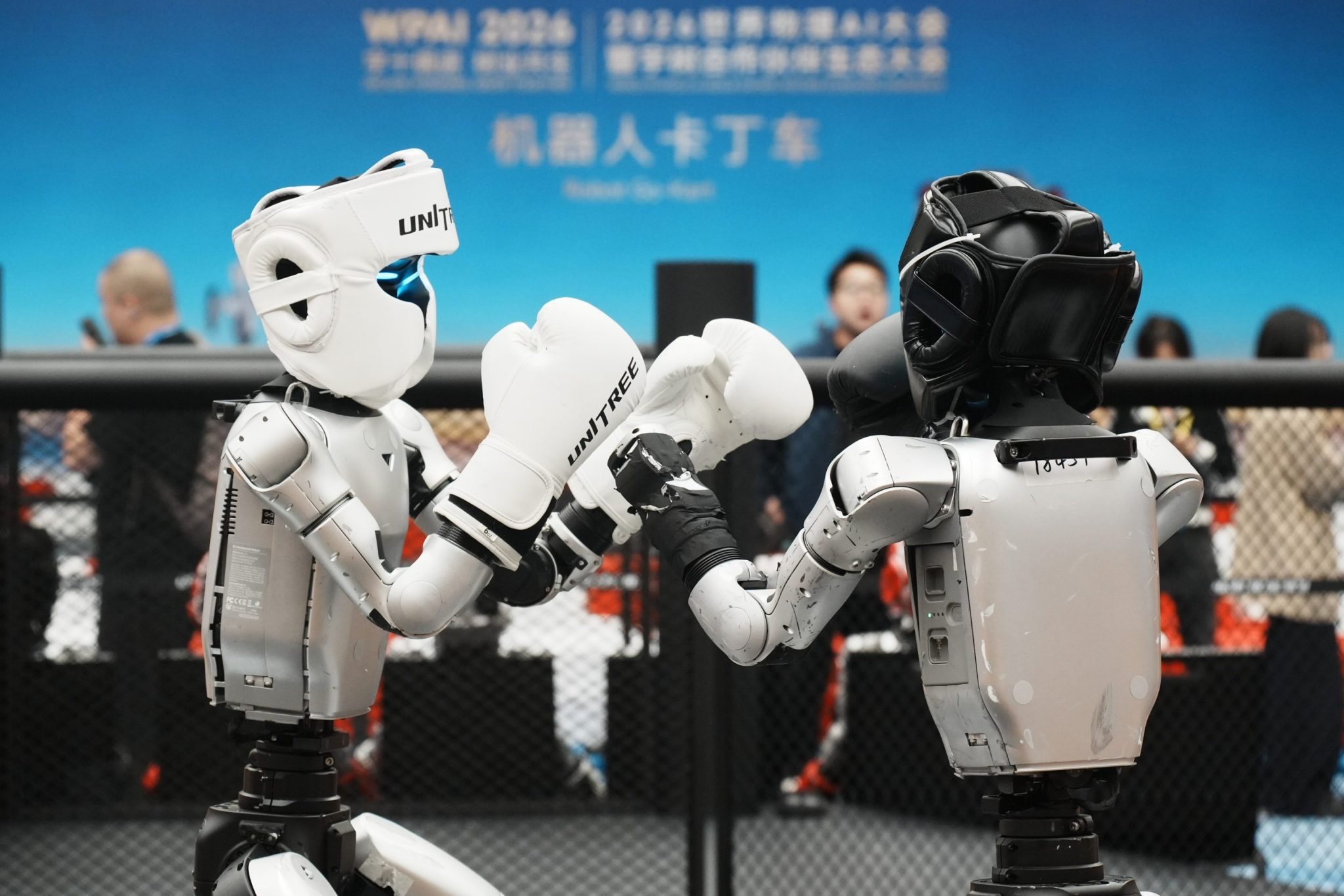
In August, at Beijing’s World Humanoid Robot Games, a robot called Tiangong Ultra ran 100 meters in 8.64 seconds, almost a second faster than Usain Bolt’s world record. A year earlier, at the Games’ first edition, the winning time had been 21.5 seconds. Yet this year’s champion could not stop: it crashed into the padded barrier beyond the finish line, along with several of its rivals. That is physical AI in a single race: breathtaking progress on some skills, persistent weakness on others. Knowing where that boundary lies, and how fast it is moving, is now a strategic question for every executive.
This fall, we spent a week in Shenzhen and Beijing visiting robotics companies, from start-ups founded by former Huawei and DJI engineers to firms that already ship robots by the tens of thousands. The founders we met cared less about sprint records than about one question: where can a robot be trusted to work today, and where can it not? Their answers convinced us of two things. Physical AI is the real AI revolution. And it is arriving far faster than companies or governments are preparing for.
The question has a familiar shape. In 2023, one of us was part of a team of researchers from Harvard Business School and other universities that ran a field experiment with 758 BCG consultants. On tasks within GPT-4’s reach, consultants using it finished 25% faster and produced work rated more than 40% higher in quality. On a task just beyond that reach, they were 19 percentage points less likely to reach the right answer. We called the boundary the jagged technological frontier: AI’s capabilities are uneven, and you often discover the edge only after you have crossed it.
Robots face a frontier of their own, shaped by both the task and the physical environment. Welding a car body to a fraction of a millimeter is a solved problem; clearing a cluttered kitchen table is still a research challenge. Roboticists have known this since the 1980s, when Hans Moravec observed that what is hard for humans is often easy for machines, and the reverse. What has changed is how fast the frontier now moves.
The stakes go well beyond robotics. Since ChatGPT, the conventional wisdom has been that AI would mostly transform knowledge work. Software could reshape how we write and decide, while the physical work of building things and caring for people stayed beyond its reach. Physical AI closes that gap and reaches the blue-collar jobs the first wave spared. It is the moment AI leaves the screen and enters every place where people work and live.
We find it useful to picture that frontier running through four rooms. The factory comes first, with fixed layouts and repeatable motions. The warehouse is structured but busier. Commercial spaces such as supermarkets or hospitals are open to the public, yet bounded and mapped. The home comes last. No two are alike, and a robot must cope with objects that are never where they should be. Our estimate: cleaning and inspection are already at scale; manipulation on assembly lines should follow within three years; restocking shelves and serving customers within five; general-purpose help at home within 10 to 15.
The Beijing sprint shows why the frontier is so jagged. Engineers describe robot intelligence in layers, and Figure, the California start-up, has published the clearest public account in its Helix 02 system. System 0 controls balance and stability; Figure says a single learned model of 10 million parameters replaced 109,504 lines of hand-written code. System 1 turns perception into action, such as grasping an object. System 2 reasons and plans when the situation is unfamiliar. System 0 has raced ahead, which is why robots can sprint. System 1 is still learning to handle the unexpected, which is why they crash into barriers and fumble unfamiliar objects. Better AI models, real-world training data and increasingly affordable computing power are pushing the frontier forward. Each deployment can generate data to train the next model. The pace of progress seen in robots’ legs is now reaching their hands.
Conventional automation has already crossed much of the first two rooms. China installed 354,000 industrial robots in 2025, 59% of the world total, according to the International Federation of Robotics. The United States, up 12% to 38,400 units, overtook Japan as the second-largest market, while installations in the European Union fell 11%. Amazon deployed its one millionth robot in July 2025.
The next wave will bring robots that manipulate objects in spaces designed for humans, which is precisely why factories will not need to be rebuilt around them. These robots will not always walk: on flat floors, wheels are often cheaper and more stable. At BMW’s Spartanburg plant in South Carolina, Figure’s humanoids spent 11 months loading sheet-metal parts on a live production line, working 10-hour shifts. In China, AgiBot reported a 99.99% success rate over 64,828 tasks during a six-day livestream at Longcheer’s tablet factory in Nanchang. In Europe, at Novares’ automotive plant in Spain, a Chinese Unitree G1-D equipped with French intelligence developed by Innov8 Robotics and Bleu Robotics autonomously manipulated 207 parts with a reported 99.5% success rate. These are early milestones, not yet proof of industrial-scale economics. Robots are already being tested for loading, unloading, depalletizing, sorting, pick and place and insertion tasks in real industrial environments. The challenge is to move from successful trials to reliable, large-scale deployment, particularly when handling unfamiliar objects and changing conditions.
The third room is being crossed now, and this is where executives should look hardest. This year, Swiss discounter Denner, part of the Migros group, began rolling out 200 cleaning robots from Shenzhen-based Pudu Robotics, which says it has shipped more than 130,000 robots worldwide. The telling detail is organizational. The rollout was run by Robobee, a local distributor that trained store staff and handles maintenance, while employees prepare spaces and manage the exceptions the robots cannot. The devil is as much in the organization of work as in the robot.
China is already testing the next step, around the clock. In November, AgiBot ran six humanoids for 24 hours in a Shanghai convenience store, restocking shelves and making coffee; four of the six passed the final assessment. In Hong Kong, Galbot has opened three stores, each managed by a humanoid working without a remote operator.
The home is the last room, but the path into it is visible. Robotic vacuums and lawn mowers are already there, and companion robots will familiarize families with machines long before general-purpose assistants become reliable. Humanoids will then have an edge, because our homes are designed around human bodies. In ageing societies that cannot recruit enough care workers, the impact could be enormous: a robot does not tire at three in the morning, nor lose patience with a child who will not eat or a parent who asks the same question for the tenth time. Adoption will depend as much on trust as on technology.
A strategic question came up again and again in China: will physical AI be built like Apple or like Android? Figure has chosen integration. Its CEO, Brett Adcock, argued that the company could not outsource its intelligence any more than its hardware. Nvidia is betting on layers, offering open foundation models and the chips to run them, while Chinese firms such as D-Robotics supply chips and development tools to robot makers. It is too early to call a winner. Our hunch is that specialized machines will run on shared intelligence, as phones run on Android, while the most demanding applications will favor integration at first. Either way, choosing a robot supplier is a bet on architecture: an integrated robot is easier to deploy and harder to leave.
The geopolitical stakes are high. China’s manufacturing ecosystem is driving hardware costs down at remarkable speed, and American and Chinese companies are racing to build the models that will run these machines. Europe’s opening may lie in integration and fleet operations. The Novares pilot hints at it: Chinese hardware running French intelligence in a European factory. Who will own the data, and ultimately the customer, is wide open.
This is why speed matters. When our consultants stepped outside the frontier, the cost was a flawed memo. When a robot does, it is a damaged shelf or an injured worker. History offers a sobering comparison. In 1899, nearly two decades after Edison’s first power stations, electric motors still drove less than 5% of American factory machinery; they passed half only in the early 1920s, because plants had to be rebuilt around them. Physical AI faces no such delay: robots designed for human environments can step straight into existing plants and stores. Few companies, and few societies, have ever had to absorb a change this profound in so short a time.
And the rules are not ready. Europe’s new Machinery Regulation applies from January 2027, but its AI-specific requirements were pushed to a delegated act due by August 2028. China published its first national standard framework for humanoid robots in February. In the United States, employers rely on industrial-robot standards that assume a robot will not fall over, and ISO 25785-1, the first international standard for robots that must actively balance, is still in draft.
For companies, the first step is surprisingly simple. Film a physically demanding or hazardous task in its real environment and send the video to a robotics specialist; it will tell you more than any technology presentation. Then deploy where robots already work and experiment where they are advancing, while training the technicians who will keep them running. Boards should be asking now which tasks could be automated within three years, and how work must be reorganized around them.
Governments face the same clock. Vocational systems built to train operators of fixed equipment must start producing technicians for machines that learn, and they have only a few years to do it. The task is to prepare for machines that will take over part of human work, and to redesign how humans and machines work together.
Generative AI taught managers that the frontier is jagged. Physical AI will teach them that it advances room by room, task by task, and faster than the institutions around it. It is already coming in through the service entrance. Within three years it will be on the assembly line, and within 10 to 15 years in our homes. Once AI has a body, nothing will remain outside its reach. The companies and governments that start preparing now will set the terms; the others will have to accept them.
The opinions expressed in Fortune.com commentary pieces are solely the views of their authors and do not necessarily reflect the opinions and beliefs of Fortune.
This story was originally featured on Fortune.com