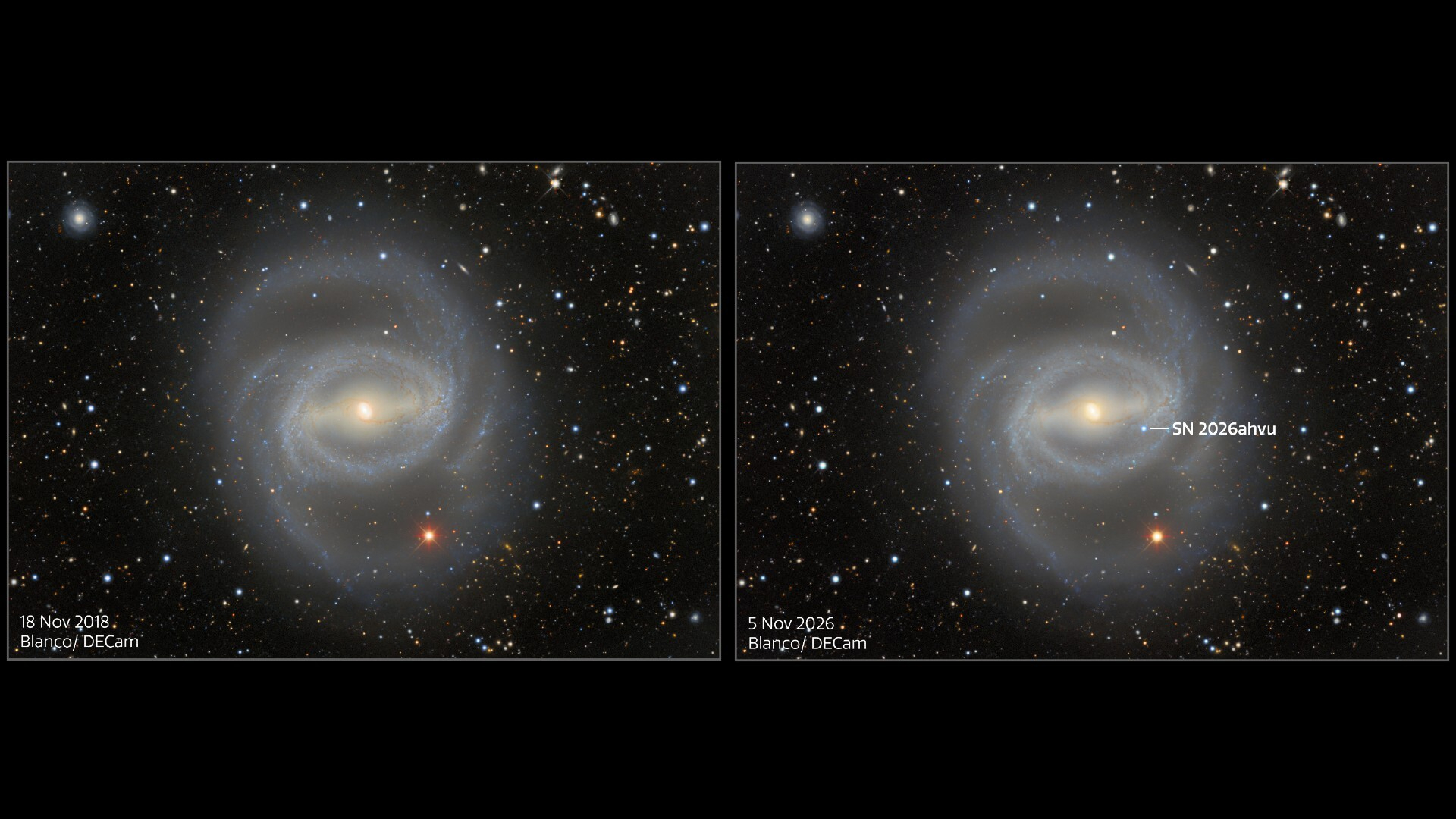
A new supernova has been spotted exploding in the spiral galaxy NGC 1433, about 50 million light-years from Earth.
What is it?
Researchers have discovered a new supernova called SN 2026ahvu. A Type Ia supernova, this event took place in a system with two stars orbiting one another (also known as a binary system), in which typically one star is an exploding white dwarf.
During most type Ia supernovae, the white dwarf pulls material away from the other star until enough accumulates on its surface to create an explosion.
Finding galaxies where stellar explosions are taking place isn't a rarity. However, this supernova is unique in how early it was captured. If the supernova were starting to dim, researchers might infer that the event was ending. However, according to details shared when it was first spotted, as well as later observations, this supernova was discovered while getting brighter.
This indicates that the supernova was likely caught early in the process of exploding, providing researchers with a unique opportunity to observe the event as it is taking place. By exploring observations of the galaxy before, during and (in the future) after the supernova event, researchers can investigate this type Ia supernova and how it affected the system in which it took place.
Why is it incredible?
Scientists made this discovery using ATLAS, or the Asteroid Terrestrial-impact System, which is a robotic astronomical survey made up of telescopes across both hemispheres.
ATLAS is designed to spot incoming near-Earth objects like asteroids before they can reach Earth. It's essentially an asteroid impact early warning system.
But just because that's what the system is designed for doesn't mean that's all it can do. The system can also spot other objects moving through space and, in this instance, it was able to capture observations of this supernova.
Following its initial discovery, other observations of the supernova were made using NOIRLab's Dark Energy Camera (DECam) and Gemini South telescope.