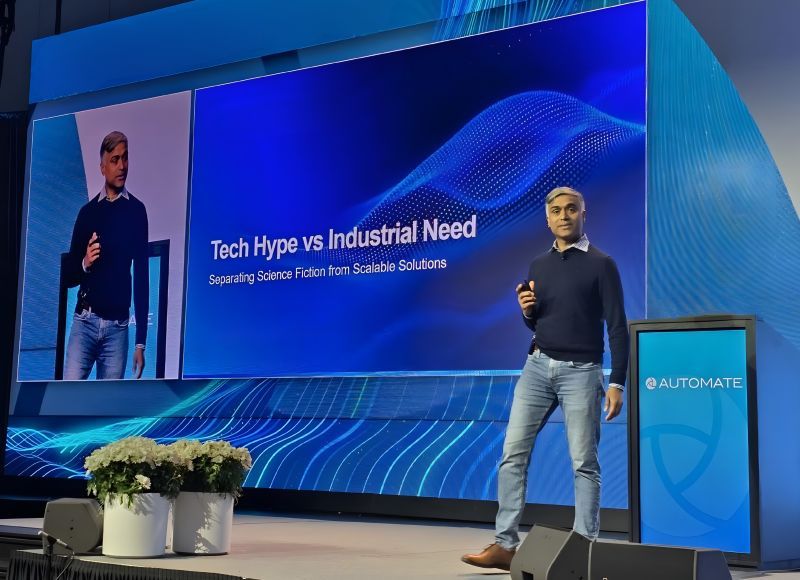
“My dad is a mechanical engineer. I’m a mechanical engineer,” Ujjwal Kumar told Fortune. His father, he said, “was thankful about the fact that he had a job.” The next generation won’t be: “my son won’t work in the kind of factories I was okay with, my dad was happy with.”
Kumar has spent 27 years remaking those factories. He started at General Motors in Detroit, spent 10 years at GE and seven at Honeywell, ran the robot maker Teradyne Robotics, and is now president of Siemens’ automation business in the Americas. He says he’s meeting five or six CEOs a week because of a wave of new factory projects, pitching them the controllers, software and robots that run modern plants. He also thinks the tech industry did lasting damage with how it talked about what AI would do to workers.
“The AI industry, especially the high-tech story coming out of Silicon Valley was pretty toxic and self-serving,” Kumar said. “It was almost like gloating, saying, ‘Oh, it is a good thing that it is eliminating every job.’”
Kumar didn’t name anyone, but the best-known version of the warning came from Anthropic CEO Dario Amodei, who told Axios in May 2025 that AI could eliminate half of all entry-level white-collar jobs within five years and push unemployment as high as 10% to 20%.
“That is not how we in the industrial world talk,” Kumar said. “You won’t see anyone from the industrial DNA talking like that.” He said industrial companies have raised it with their tech partners: “I have no idea why we would gloat about human beings losing their job, everybody going on UBI [universal basic income]. Like, that doesn’t excite people.”
Data centers became a political flashpoint in the midterm elections, with Democrats campaigning against big projects and voters pushing back over electricity costs, water use and a lack of local say, and the opposition wasn’t confined to one party. What ensued was a “blue tsunami” that saw Democrats win in states such as Mississippi and Texas, where they hadn’t won in decades, and in Kansas, where it’s been nearly a century.
Kumar was at the SuperComputing2026 trade show in Chicago the week after the vote, and he said the results reshuffled what the industry talked about. “If this Semicon had happened pre-election, we would be prioritizing on different set of things versus what we ended up prioritizing,” he said. “And I’m proud of us as an industry to re-pivot so quickly.”
He doesn’t read the vote as a rejection of building. “They [the voters] said, ‘The way you are doing data centers, it is not helping me in my community,'” he said. He agreed that communities should set the limits; a company that sets up anywhere and does whatever it wants to local water and workers, he said, isn’t doing its job. “That is not running a business.” He called the backlash a “boundary condition,” the kind of constraint engineers like, and said the alternative is worse: “We don’t want to become the next tobacco industry.”
Kumar sees a “greenfield” building boom. By his count, about 30,000 new industrial projects have been announced across the Americas in recent months, to be awarded over the next three years, about a third of them in the U.S.
Only about 3,000 are data centers and chip plants, while food and beverage plants are Siemens’ biggest category in the Americas. “We have never seen this level of greenfield work. We used to be more of a brownfield continent,” he said. The last comparable wave, he said, speaking generally based on his perceptions at the time as an industry executive, was in China about seven or eight years ago, with 8,000 to 10,000 projects.
To staff it, Siemens USA pledged in December 2025 to train 200,000 electricians and manufacturing workers by 2030. Kumar pointed to Siemens’ $190 million plant in Fort Worth, which opened in March 2025 to make electrical switchgear mostly for data centers and was staffed partly with people who had never worked in manufacturing. “We hired teachers, chefs, delivery drivers, and we trained them,” he said. The company said the plant’s current headcount is approximately 800 workers, of which roughy a quarter had no prior manufacturing experience.
In addition, Siemens’ philanthropic arm, the Siemens Foundation, launched Careers Electric in February 2026 to train 25,000 new electricians in its first 10 years. Siemens is also a founding member of the Foundry School initiative, announced in September 2026 by the U.S. State Department, to train the future workforce of the nation’s reindustrialization movement.
Siemens has announced some cuts at the same time, even as the company told Fortune that its overall headcount has remained “broadly stable” since 2025, at roughly 300,000 globally. In March of that year, the company said it would cut more than 6,000 jobs worldwide, including about 5,600 by 2027 in its factory automation business.
“So there is a redefinition of the work going on throughout the economy and also in Siemens,” he said, adding that “we have used automation to move our human workers to more fulfilling jobs.” His pitch: “You should come to one of our factories to see how net-net via automation and robotics is adding jobs, but different kinds of jobs.”
A brownfield continent
In manufacturing terms, brownfield means upgrading a plant that already exists, and greenfield means building from scratch on new land. Kumar thinks most Americans, and plenty of executives, haven’t caught up to the difference. “It completely changes how you build your factories,” he said. “We don’t understand that greenfield needs a very different kind of thinking. We will not build a factory today the way we used to build it 30 years back.”
His case for greenfield is about how factories get designed. In an old plant, he said, you work around constraints and tweak what’s there. The new plants, in Kumar’s telling, have to look different to get built and staffed.
“In this generation, we in the manufacturing world, we interestingly are competing with Starbucks barista jobs,” he said. Automation, he argued, also wipes out the old case for offshoring: “whether I’m doing it in Shenzhen or doing it in Chicago, it doesn’t matter.” And the machines carry the expertise that used to take workers decades to build. “The decades of experience needed is now coded into the machine’s intelligence itself. So now you can start with less skilled people.”
The public data hasn’t caught up to his count. Spending on new manufacturing construction fell 22.4% in the first five months of 2026 compared with a year earlier, according to an analysis of Census Bureau data by the American Council of Engineering Companies, which found money shifting toward power and digital infrastructure. Announced projects can take years to show up as spending, if they show up at all.
The difference between his side of the business and Silicon Valley’s, he said, comes down to what people want from work. “We human beings, we don’t want to just go sit on our lap, do nothing. We want to do something fulfilling.” Kumar is betting that the greenfield era will be more fulfilling than not, and he just got an idea of how skeptical so much of the workforce is about that.
This story was originally featured on Fortune.com