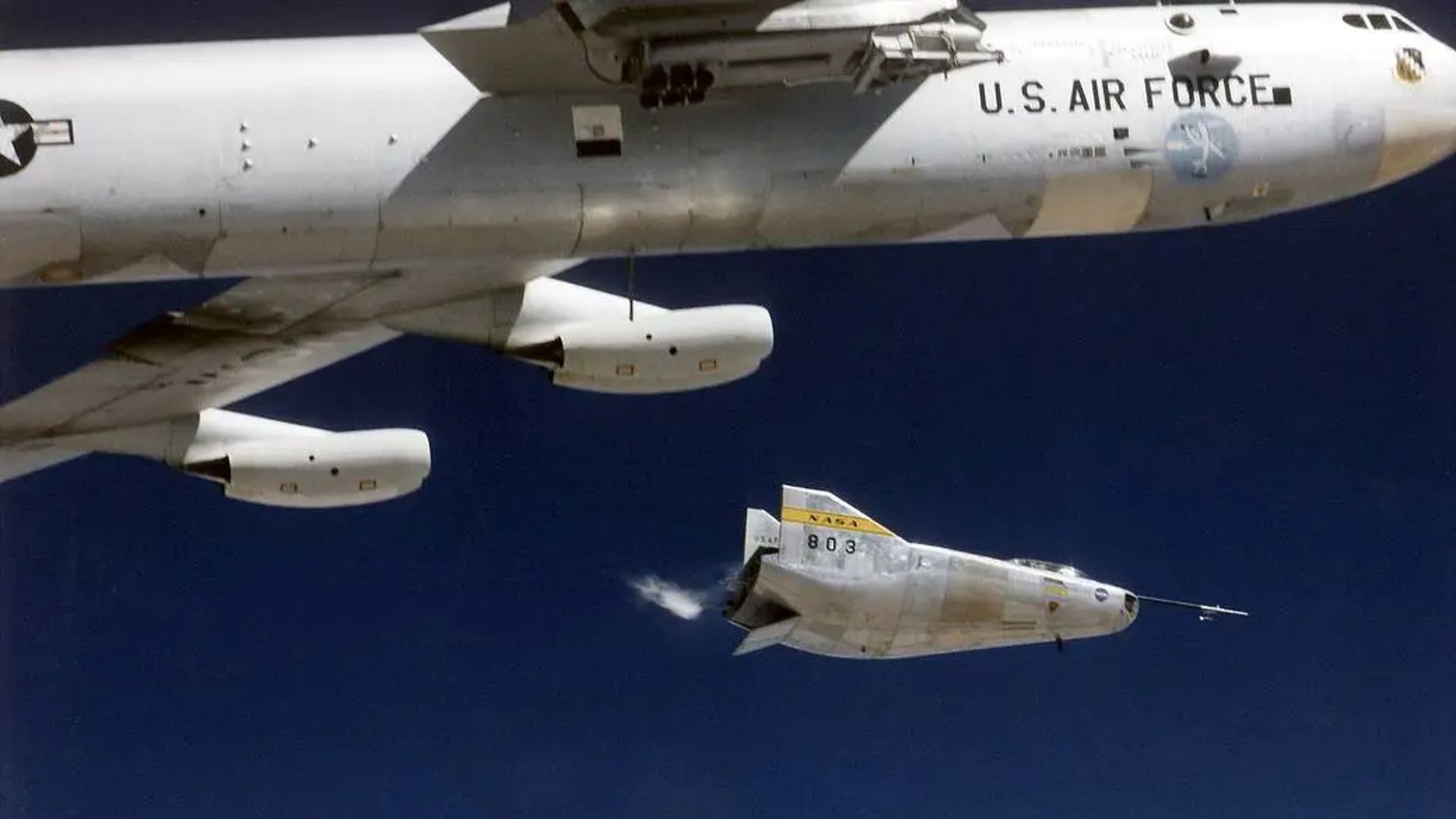
On Nov. 25, 1970, an experimental aircraft called the Northrop M2-F3 made its first powered flight.
The M2-F3 aircraft was a heavyweight "lifting body" designed to test its ability to produce most of its lift through its fuselage instead of wings. It's commonly referred to as a "wingless" aircraft.
After Air Force test pilot Bill Dana took the M2-F3 on three unpowered glide test flights, he did the first powered flight, too. Dana soared to an altitude of 45,000 feet during this flight, which lasted just over 6 minutes. He didn't break the sound barrier this time, but he did on later flights.
The M2-F3 flew a total of 27 missions in its three-year flight history. Its top speed was 1.6 times the speed of sound, and its top altitude was 71,500 feet.
NASA's M2-F3 lifting body drops from its carrier plane during a test flight in 1970. (Image credit: NASA)Why it mattered
In the late 1960s and early 1970s, NASA was investigating lifting bodies as an approach to both new aircraft and what future spacecraft, and as its number suggests, the M2-F3 was not the first of its kind.
In fact, the M2-F3 was a rebuilt version of its predecessor, the M2-F2 lifting body, after that vehicle crashed in a dry lake bed in California's Mojave Desert during an unpowered test flight. That crash (which appears in the opening of the TV show "The Six-Million-Dollar Man") led to upgrades for a better handling lifting body, NASA said.
"When the M2-F2 was rebuilt and redesignated the M2-F3, it was modified with an additional third vertical fin – centered between the tip fins – to improve control characteristics," NASA wrote in an overview.
Unpowered glide flights for the M2-F3 began in June 1970, but Dana's flight on Nov. 25 of that year was the first time the vehicle fired up its rocket engine to test its controls under powered flight. One vital upgrade on the vehicle was a set of reaction control thrusters to help maintain its orientation.
"A reaction jet control system, similar to thrusters used on orbiting spacecraft, was also installed on the M2-F3 to obtain research data about their effectiveness for vehicle control," NASA wrote. "As the M2-F3’s portion of the lifting body program neared an end, it evaluated a rate command augmentation control system and a side-arm control stick similar to side-arm controllers now used on many modern aircraft."
If you want, you can see the M2-F3 vehicle today. NASA donated it to the Smithsonian Institution. It is now hanging at the National Air and Space Museum in Washington, D.C.
Want more space history? Check out our full On This Day In Space Story archive and watch our On This Day In Space videos on YouTube.