On Nov. 10, 2013, Europe's GOCE satellite fell to Earth after four years in orbit mapping the planet's gravitational field.
GOCE, its name was short for Gravity field and steady-state Ocean Circulation Explorer, launched in 2009 on a mission to map Earth's gravity like never before. But despite that successful mission, it was doomed in 2013 when it ran out of fuel.
At the time, controllers weren't sure where GOCE would fall back to Earth. Some people worried that it might crash into a populated area. However, the small spacecraft broke up in the atmosphere and didn't cause any property damage.
It disintegrated about 50 miles above the Falkland Islands in the South Atlantic Ocean. The European Space Agency called the mission a success. GOCE lasted far longer than expected. It showed small variations in Earth's gravity, mapped the structure of Earth's crust and mantle, and tracked ocean currents.
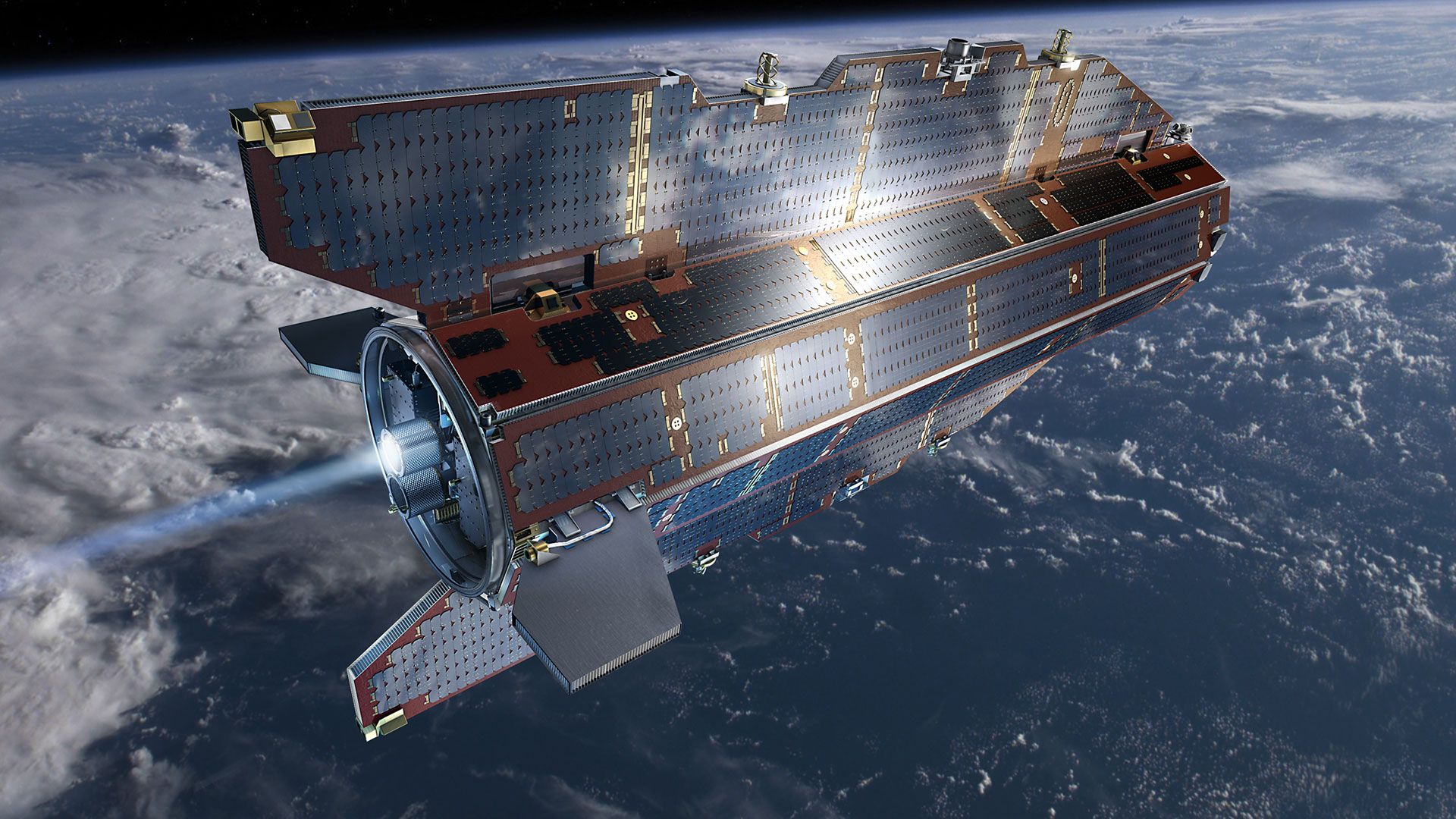
Artist's rendering of the "Ferrari of space," the European Space Agency's Gravity field and steady-state Ocean Circulation Explorer (GOCE), before it fell from space in 2013. (Image credit: European Space Agency)Why it mattered
The GOCE satellite was a sleek spacecraft, with fins covered in solar panels that gave it a futuristic design. In fact, its look earned it a pretty cool nickname.
"GOCE's sleek, elegant aerodynamic design — responsible for it being dubbed the 'Ferrari of space' — immediately set it apart from most other satellites,." ESA officials said in a description.
There was more than looks behind GOCE's design. In order to generate the best map ever of Earth's gravitational field, GOCE had to fly in an orbit so low — just 139 miles (224 kilometers) — it needed to counteract the drag from the gossamer thin atmosphere of Earth at that altitude. The International Space Station orbits Earth at nearly twice that altitude.
GOCE was powered by an xenon ion engine that allowed to maintain its low orbit for four years. Once it ran out of fuel, the 1-ton satellite could not maintain its position in space, leading to a fiery plunge to Earth.
The large size of GOCE — it weighed 2,425 pounds (1,100 kilograms) and was 17 feet (5.3 meters) long and 3.2 feet (1 m) wide — made its reentry stand out, particularly since at least 25% of the satellite was expected to reach the Earth's surface.
Want more space history? Check out our full On This Day In Space Story archive and watch our On This Day In Space videos on YouTube.