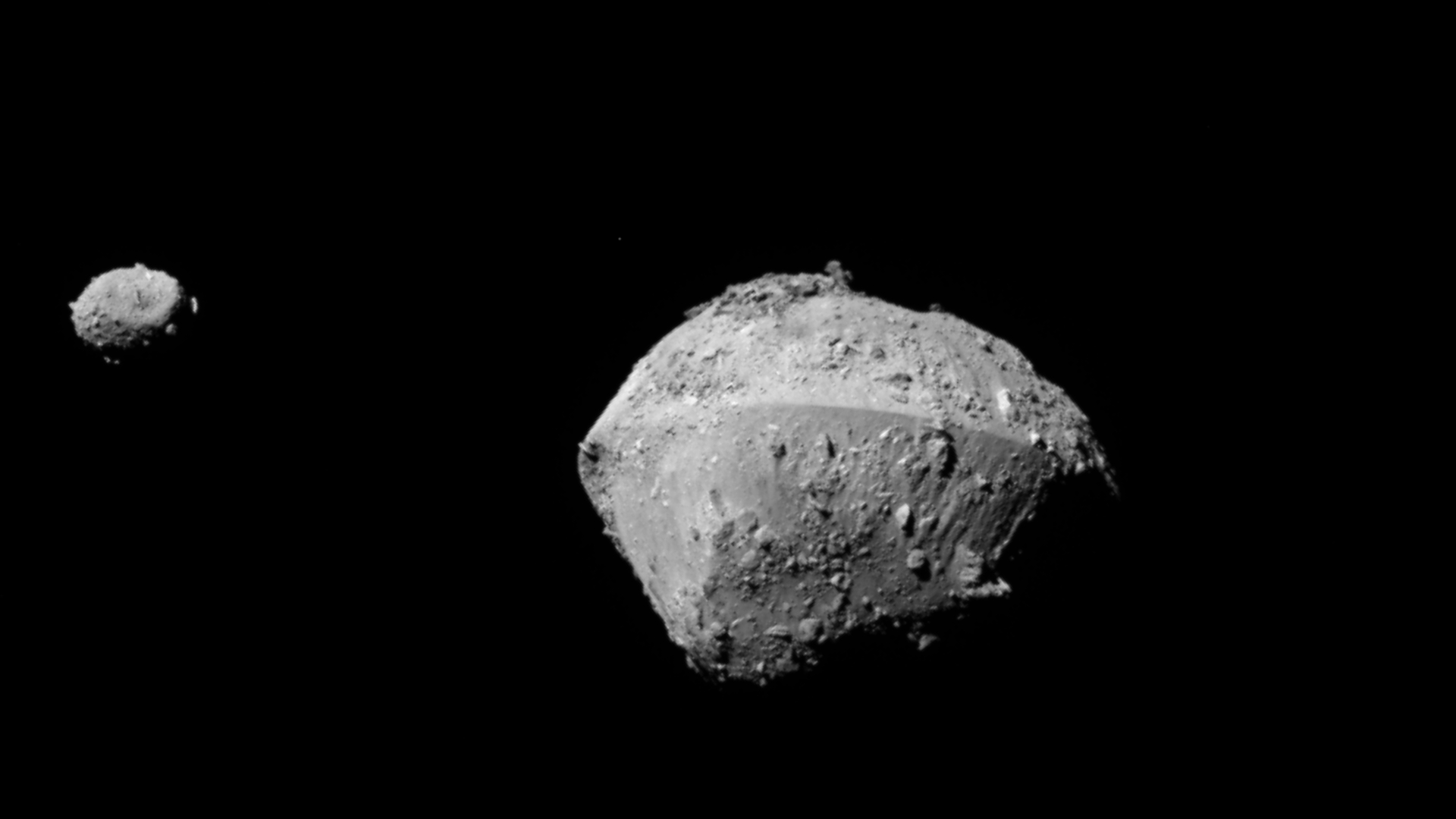
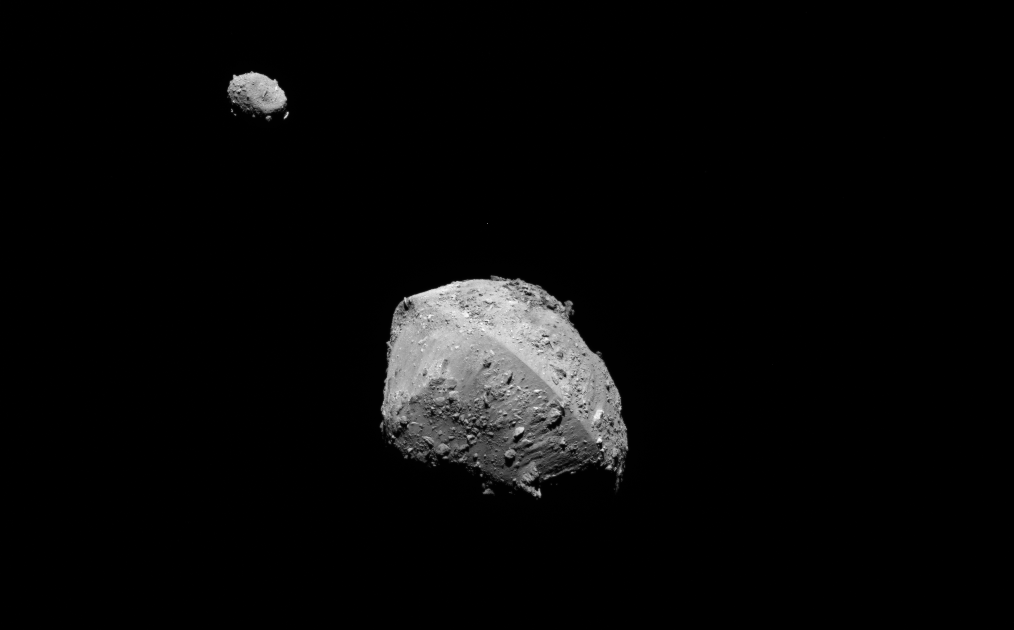
This Hera Asteroid Framing Camera image shows Dimorphos (top left) in orbit around Didymos (centre), with the crater caused by the 2022 DART impact clearly visible. This image was taken at a distance of 29 km on 7 November, with a spatial resolution of 2.7 m per pixel. Credit: ESA
The European Space Agency’s Hera spacecraft has revealed that NASA’s DART impact gouged out a stadium-sized crater in asteroid Dimorphos, almost as wide as the asteroid itself, giving the impression that one side of the asteroid has been completely flattened. At the same time, the asteroid is now tumbling wildly, with hundreds of previously unknown boulders orbiting around it.
The asteroid ‘autopsy’ that is now underway is critical in determining how reliably the impact deflection technique can be used for protecting Earth against potentially hazardous asteroids.
Why we deliberately impacted an asteroid
While the 151 metre-wide asteroid moonlet Dimorphos and its 730 metre-wide parent asteroid Didymos posed no threat to Earth themselves, they were subject to humanity’s first ever large-scale planetary defence experiment designed to test if we could deflect an asteroid from its previous path.
On 26 September 2022, NASA’s 580 kg DART spacecraft deliberately struck Dimorphos, at a speed of 6.1 km/s. Initial results showed that the impact released a debris plume extending across space for tens of thousands of kilometres, and indeed shortened Dimorphos’s orbit around Didymos – by roughly 33 minutes.
That result clearly demonstrated that a kinetic impact can measurably redirect a small asteroid. However, the deflection was larger than models predicted, and at that time it was not possible to determine how the impact changed Dimorphos’s surface, interior, mass, and shape.
https://astronomynow.com/wp-content/uploads/2026/11/AFC_Dimorphos_orbit_north_261103.mp4
Dimorphos orbiting Didymos This animation shows one orbit of Dimorphos (the smaller asteroid moonlet) around Didymos (centre), focusing mainly on the northern hemisphere of Didymos. The crater left by DART’s impact into Dimorphos moves in and out of visibility as it rotates along its orbit. Dimorphos orbits Didymos with an average separation of 1 km. Didymos rotates once on its axis every 2 hours and 15 mins. Credit: ESA.
What the new images show
Hera has now reached the binary asteroid system after a two-year journey, where it will become the first mission to explore an asteroid that has its own moon.
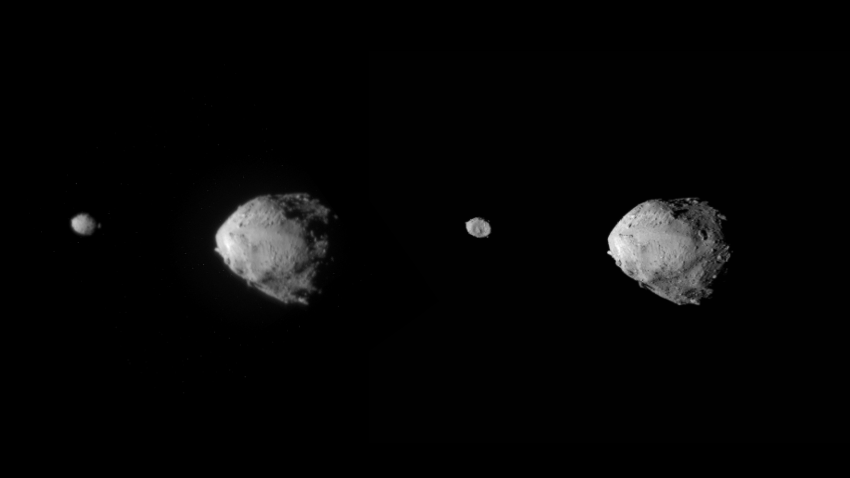
Its approach images focused on the larger asteroid, Didymos, providing views of its previously unseen hemisphere. Before-and-after images show that – at least at the current resolution that the images provide – Didymos appears to have undergone no major modifications from DART’s impact with its moon. The same boulder fields and central equatorial ridge remain visible.
The new Dimorphos images, however, tell a different story. The result of the impact is clearly visible: a large debris-strewn crater spans almost the full length of the tiny moonlet. The full details of the crater and its internal features will only be revealed with closer imaging over the coming weeks and months. The other side of the asteroid – also now seen for the first time – appears to be unaffected by the impact.
“After four years of waiting and speculating we can finally see what Dimorphos looks like. Where there was once a rounded face is now a big crater almost as large as the body itself, which is really spectacular,” said Sabina Raducan, planetary scientist at the International Space Science Institute (ISSI), and Vrije Universiteit Brussels, in an ESA press briefing this morning.
“The impact also changed the dynamics. Before, Dimorphos was more like our own Moon, always showing the same face [to Didymos]. Now it is very chaotic, tumbling, rolling like a barrel around Didymos.”
Comparing images of the Didymos system before (left) and after (right) the 2022 impact of NASA’s DART mission, showing the Dimorphos moonlet completely transformed. Credit: Left: NASA/Johns Hopkins APL; Right: ESA.
Unexpected flying boulders
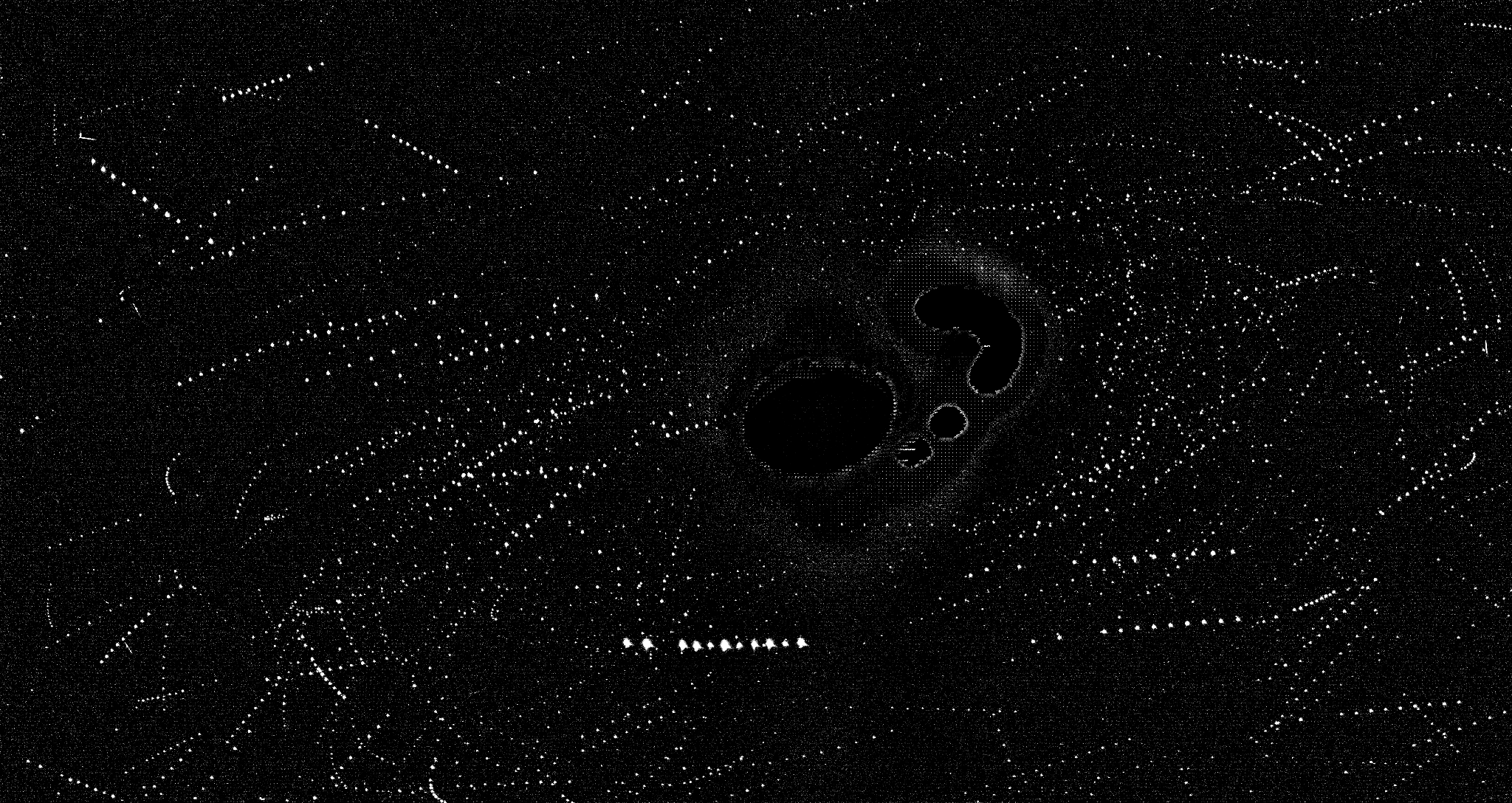
Perhaps the biggest surprise, however, is the presence of hundreds of boulders revealed in long-exposure images.
“Every space mission has surprises, but there was a particularly big one in store for Hera,” described Naomi Murdoch, planetary scientist at the Université de Toulouse.
“As we approached Didymos and Dimorphos, we quickly realised the asteroids were not alone. Hera has observed hundreds of boulders moving around these two asteroids, ranging from football-sized to washing machine-sized.”
Hundreds of boulders of differing sizes are in motion around the Didymos-Dimorphos system. This image combines 11 long-exposure Hyperscout H images, with the two asteroids subtracted from the image for improved visualisation of the boulders. The image spans about 7 km across. The images were acquired on 6 November with an approximate distance of 29.9 km from the asteroids. Credit: ESA.The science teams need more images and data to determine if the boulders arose from the impact itself, or perhaps were carved off from the rapidly rotating larger asteroid – a popular theory for the origin of Dimorphos itself – or if there is another explanation. Even the DART spacecraft was travelling too fast on its collision course to know if the boulders were already there in 2022.
As for flying in such unexpectedly challenging conditions, Heli Greus, ESA’s Hera Product Assurance manager, said: “Hera has already been there for three weeks so we have already identified part of them: we know where they are and so we know where not to go.”
What comes next for Hera
Over the coming months, Hera will fly closer to the asteroids and conduct a detailed survey of Dimorphos. The spacecraft is currently flying at about 15-20 km away from the binary pair, in rectangular orbits at an average velocity of just 12 cm/s.
Sylvain Lodiot, Hera Flight Director, confirmed today that: “Things are progressing nominally. We are flying 13 km as of mid-December. We were intending to go to 8 km, but we are taking a safer distance to get some more confidence before moving closer. We are on track for the CubeSat deployment in January.”
Hera carries two shoebox-sized CubeSats, Milani and Juventas. Milani will study Dimorphos’s surface, composition and dust environment, while Juventas will use radar to probe beneath the asteroid’s surface and search for signs of large internal blocks, voids or finer debris. It will eventually attempt a landing.
As for Hera, the CubeSats trajectories can also be modified if a flying boulder is identified that might pose a potential collision risk, in order for them to have a successful mission.
Together, the trio of spacecraft will measure Dimorphos’s shape, volume, mass and internal structure. That combination should reveal how loosely packed the asteroid is – a crucial clue to how it responded to DART’s high-speed impact. Should it turn out that Dimorphos was pushed close to the point at which it could break apart, the implications for planetary defence would be significant. A deflection mission needs to move an asteroid onto a safer course; it must not accidentally create a swarm of hazardous fragments.
“Sixty-six million years ago, an asteroid impact changed the course of life on Earth. Today, for the first time in history, humanity is validating how to prevent such an event from happening again,” said Hera mission manager Ian Carnelli in an ESA press statement, who unveiled the new images to the public from the fitting location of the dinosaur hall of the Museum für Naturkunde Berlin this evening.
Hera’s complete investigation will help shape how humanity approaches planetary defence techniques in the future, should an asteroid pose a genuine threat.
“Every image we receive from Hera is a clue to the nature of the two asteroids and their evolutionary story,” adds Naomi. “Hera arrived three weeks ago. We have another six months to explore these asteroids and to gather even more data.”
Dive deeper into planetary defence
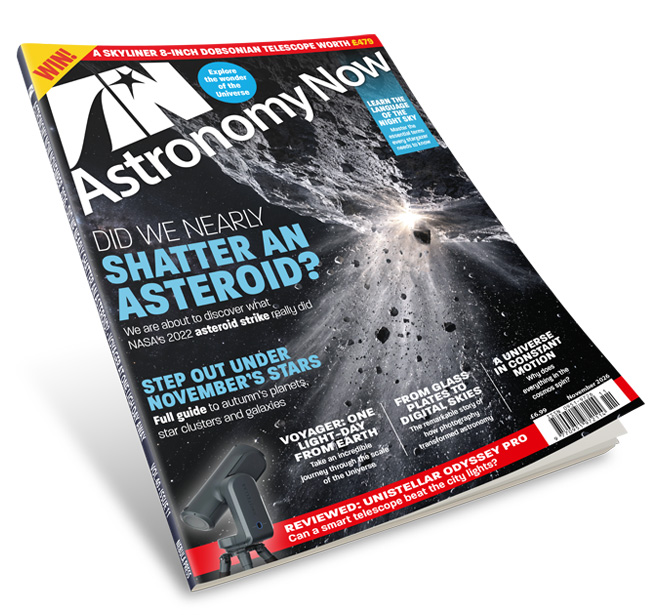
The November 2026 issue of Astronomy Now takes a deep dive into planetary defence, where Editor Stuart Clark explores what Hera’s findings could mean for future efforts to defend Earth from a hazardous asteroid. Order online or take out a digital subscription for instant access.