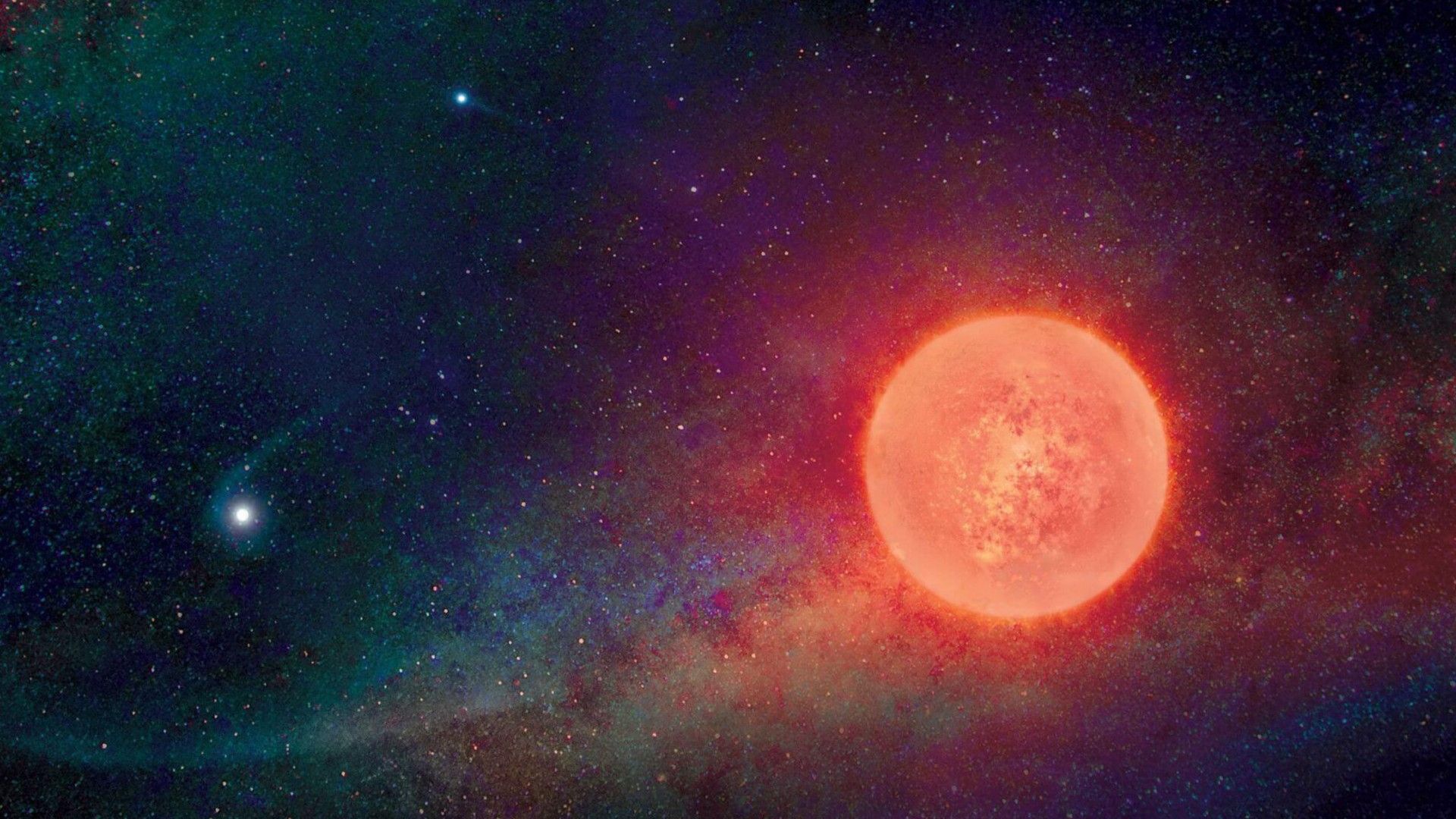
Mirach, also known as Beta Andromedae, is a moderately bright star in the constellation Andromeda. It’s a larger and more massive star than our sun. Mirach has about three to four times the sun’s mass and 100 times the sun’s diameter. It shines with about 1,900 times our sun’s total brightness.
Mirach is what’s known as a red giant star, a star in the final stages of its evolution whose outer layers have expanded. But Mirach is rather far away at 200 light-years, and thus it shines in our sky at only 2nd magnitude, a respectable brightness but not as bright as that of many other stars.
Yet Mirach is an important star to stargazers. Amateur astronomers often use this star to guide them in locating three galaxies: the Andromeda galaxy (M31), the Triangulum galaxy (M33) and a galaxy known as Mirach’s Ghost (NGC 404).
The Andromeda galaxy is possible to spot with the unaided eye or binoculars on a dark moonless night sky. The other two galaxies are much fainter. You’ll likely need a telescope to see them.
View at EarthSky Community Photos. | Jeremy Likness in Newport, Oregon, captured this telescopic view of the Andromeda galaxy on September 10, 2026. Jeremy wrote: “The numbers are mind-numbing. 2.5 million light years? One trillion stars? This week we had a run of clear, dark skies. My target: M31, the Andromeda galaxy. Our nearest galactic neighbor.” Thank you, Jeremy!Finding the Andromeda galaxy with Mirach
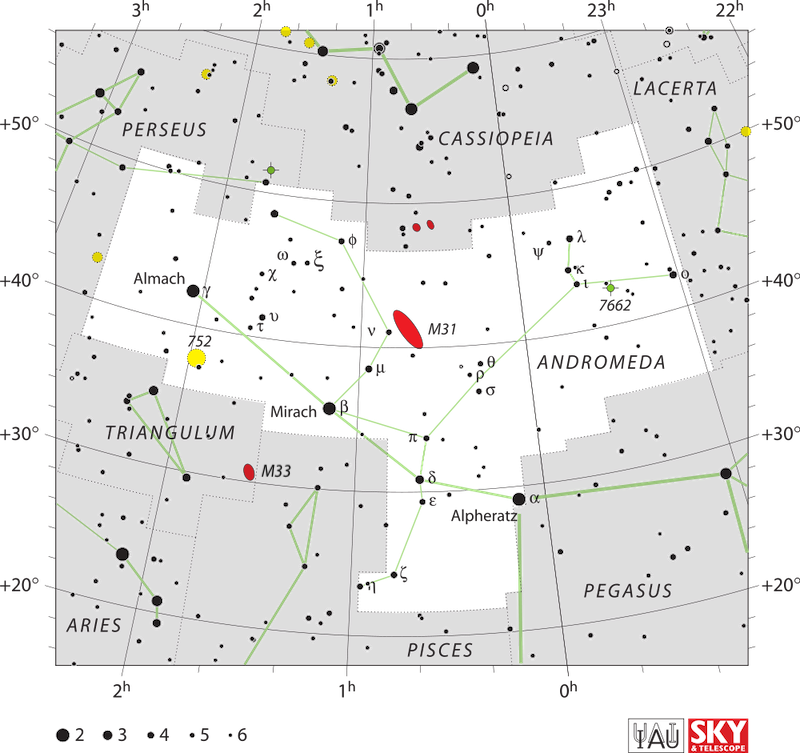
Draw an imaginary line from Mirach to the star Mu (µ) Andromedae. Then, continue extending that line for about the same distance between those two stars to reach the Andromeda Galaxy.
Under dark, moonless skies, the Andromeda galaxy appears as a smudge in the sky to the unaided eye. Even if the moon is out or under skies with moderate light pollution (like the suburbs), you can see it through binoculars. At about 2.5 million light-years away, the Andromeda galaxy is the nearest large spiral galaxy to our Milky Way. And it’s the most distant thing you can see with your eye alone.
A star map of the constellation Andromeda showing the locations of the Andromeda Galaxy (M31) and the Triangulum Galaxy (M33). Image via IAU.Finding the Triangulum galaxy (M33)
The Triangulum Galaxy, in the constellation Triangulum, is much fainter than the Andromeda Galaxy. Some people with excellent eyesight have been able to see it, unaided by telescopes or binoculars, in extraordinarily good viewing conditions. Even so, it can still be a challenge to find M33 with binoculars and small telescopes.
To find Triangulum, you’ll use the same two stars as above but star-hop in the opposite direction. Follow an imaginary line from the star Mu (µ) Andromedae to Mirach, then continue to draw that line past Mirach, for twice the distance between Mu Andromedae and Mirach, to reach the Triangulum Galaxy.
Here are 2 of the 3 galaxies you can find via the star Mirach in the constellation Andromeda. M31 is easy to find on a dark night, from a rural location. M33 is tougher to spot. Chart via IAU. View at EarthSky Community Photos. | Andy Dungan imaged this galaxy on October 29. 2025, from Colorado. Andy wrote: “Triangulum is the second closest galaxy to our own and located near the 1st closest, Andromeda, in the night sky.” Thank you, Andy!Finding Mirach’s Ghost (NGC 404)
So when you look at Mirach, you’re looking almost exactly in the direction of the galaxy labeled NGC 404 but known affectionately among astronomers as Mirach’s Ghost. That’s because the remote, fuzzy galaxy lies right next to the moderately bright star, just 1/10 degree from Mirach. A full moon is 1/2 degree wide, so you can see that’s very close.
Mirach’s Ghost is faint, just magnitude 11 in brightness. Many amateur astronomers try to spot it with their small telescopes, but due to its proximity to the brighter 2nd-magnitude Mirach, seeing the galaxy is not easy.
NGC 404 is located about 10 million light-years away, just beyond our Local Group of galaxies. The Local Group is a cluster of galaxies that includes the Milky Way, Andromeda and Triangulum galaxies. NGC 404 does not appear gravitationally bound to our Local Group.
NGC 404, also known as Mirach’s Ghost, is the bluish-white object next to orange-colored Mirach. This image was taken by Tom Wildoner using a camera attached to a 4.7 inch (120 mm) refractor telescope. Image via Tom Wildoner. Used with permission.Bottom line: Stargazers use Mirach, a moderately bright star in the constellation Andromeda, to locate three galaxies. It can help you find the Andromeda Galaxy, the Triangulum Galaxy and a galaxy known as Mirach’s Ghost (NGC 404).
The post Mirach is your guide star to finding 3 galaxies first appeared on EarthSky.