Political earthquakes marked 2026 in both Hungary and Serbia. Longtime rulers and allies Viktor Orbán and Aleksandar Vučić were voted out of office in elections that shared several similarities but also had significant differences.
While the transition of power is still underway in Serbia, Hungary’s new Prime Minister, Péter Magyar, has spent his first six months in office attempting to reform state institutions and address the legacy of authoritarianism and corruption under the previous government.
How successful has he been, and what lessons can Serbia learn from Hungary’s experience? And will Orbán and Vučić “be back”, as the latter suggested in a joint video released shortly after their electoral defeat?
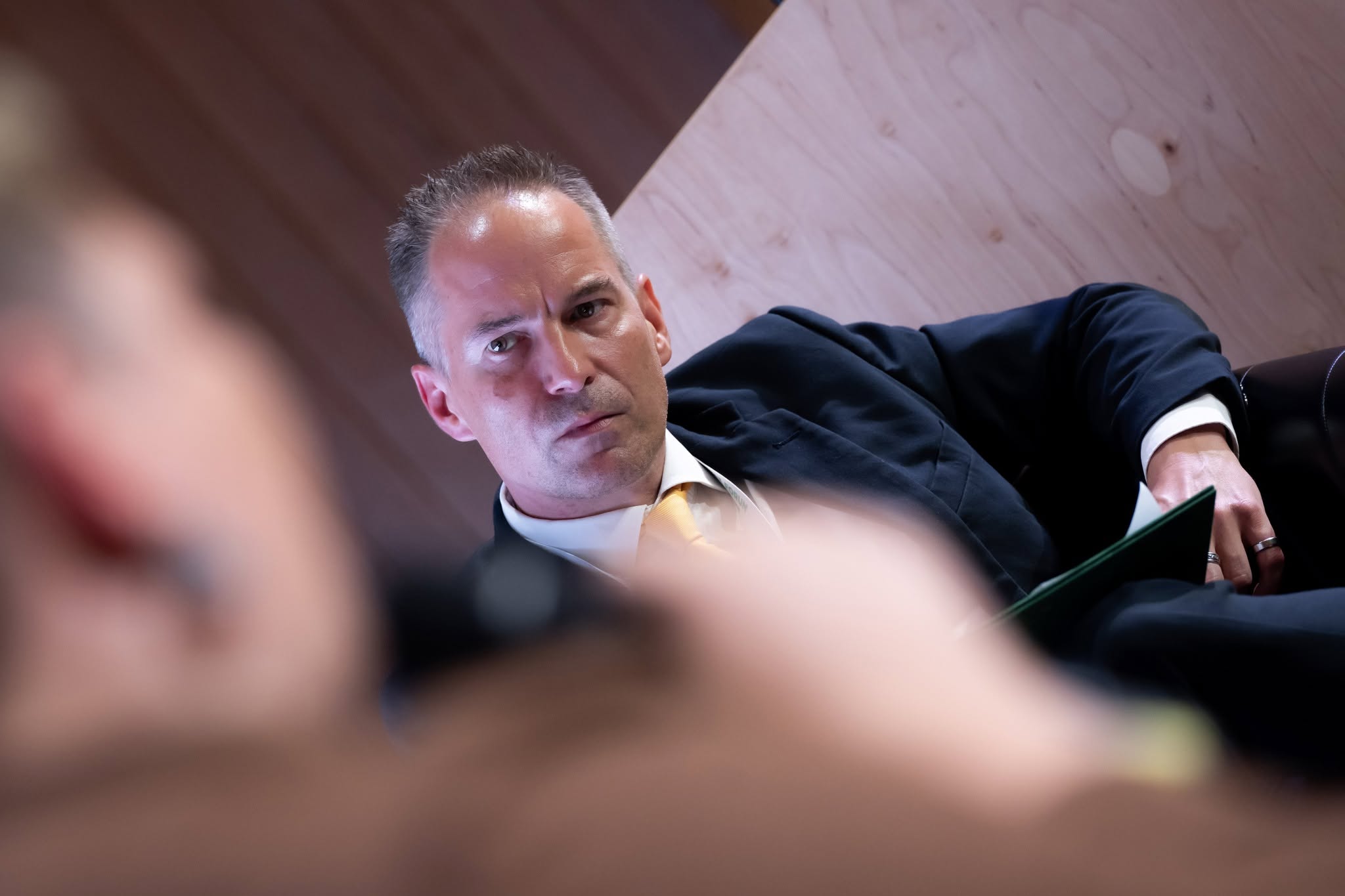
We discussed these questions with Péter Krekó, Executive Director of the Budapest-based research institute Political Capital. EWB spoke with Mr Krekó on the sidelines of the 2026 Belgrade Security Conference.
European Western Balkans: Six months after the election of Péter Magyar as Prime Minister of Hungary, how would you assess his track record so far in achieving his goal of re-democratisation of Hungary?
Péter Krekó: I would say that I’m rather satisfied so far with how the re-democratization process works. I think that the most important indicator of the commitment to re-democratization, and not just changing government and then strengthening a new government, is that there have been appointments to important positions, including the President, the Constitutional Court, the National Media Authority, independent experts, people who are taken seriously in their professions, who have also made some critical remarks on the government beforehand, and who we can expect can be a real counterbalance to the executive power and to the legislative power.
The Hungarian situation is quite interesting in the sense that you have a constitutional majority of the Tisza Party. Tisza Party is full of political novices and it is highly centralized. It doesn’t even have a strong party background, so it’s not a real, how to say, basic democratic movement, but more a center-based… And also, you have a strong man who has been elected by the voters with a mandate to change the regime. So, I think the preconditions are there for some kind of re-autocratization. And that’s why I think it’s important that there have been some changes that limit the room for maneuver for the next government as well.
For example, the term limit – there will be only two terms which a Prime Minister can serve, and then they have to resign – and broadening the powers of the Constitutional Court. I can cite many examples where decisions are made that make the new government’s and the new parliament’s mandate and powers a bit more limited than before.
EWB: What would you say is more important for re-democratization: redesign of institutions in that way, introducing term limits, expanding the scope or limiting the scope of Constitutional Court decisions and so on, or appointing the right people in right places and changing the way power is wielded in a country – having people who would be committed to democracy and protecting it in the future?
PK: I would say that both are necessary, but insufficient preconditions for re-democratization. I’m not an institutionalist myself. I’m a political scientist and social psychologist, and I don’t think that you can solve every problem through a legalistic approach, but you need the legal boundaries of your power.
And then I think the best thing you can do as a new political force is to make laws and regulations that you will be frustrated with in about one or two years. Really limiting your future ability to abuse the power. And also, I really do believe in the separation of powers and distribution of power.
Of course, there is a voter demand to be as efficient as possible. But I think in Hungary the biggest problem is not the lack of efficiency. In Hungary, the biggest problem might be that this very strong governmental majority can abuse its power. And that’s why I think these self-constraining measures are extremely important.
I’m not sure the situation is totally the same in Serbia as well, because I think you have the Student List that delegates members of parliament and government members, but I think you have to hold them accountable, and maybe it’s already, I think, a more decentralized system, and not a person-based system.
If we zoom out a bit in Hungary, I think it’s very important to change the institutions and also to appoint the right people to the right places. At the same time, the new government is highly efficient. So, I think the big question is how to satisfy voter demands to be as efficient as possible while not abusing power. I don’t think there is one solution to that question. I think it has to be context-specific, but in Hungary, I’m a bit optimistic that we are heading in that direction.
EWB: I saw that you used the term “spin democracy” to describe Péter Magyar and his government. Can you elaborate a bit? It’s a contrast to “spin dictatorship,” which was a term used for the regime under Orbán. What do you mean by spin democracy?
PK: Orbán, I think, was a real spin dictator in the sense that the Hungarian regime was even less violent than the Serbian regime. What Orbán was very good at, besides, of course, legalistic tools aiming to pass legislation to circumvent constitutional principles and so on – he was a master in manipulating information and persuading the electorate that he’s the best choice while governmental indicators were all on the decline in four consecutive elections. So, I think he was a master of manipulating information, state-sponsored disinformation, and conspiracy theories.
And in Hungary, we had the most centralized media system in the whole European Union. I think it’s similar to Serbia, but at some points, I think it was even more centralized than the Serbian one.
And I would say that Péter Magyar is maybe even better in spinning the information than Viktor Orbán was. He wants to control the narrative all the time. He wants a constant movie in Hungary. Hungarian politics could be compared to Netflix movies, or a constant action hero movie.
Just to give you one example: when there was the low level of the Danube, and there was a danger of the nuclear plant cannot receive enough water, there was a need to elevate the level of the water in the Danube and they threw huge concrete bricks into the water. And what Péter Magyar did was make a full-day action movie out of that. He was walking on the cubes in the water. It was highly mediatized, and it was very well-watched. Hungarian electorate is still very obsessed with politics, and he keeps up this excitement.
But at the same time, I think it also means that he’s centralizing the message. The journalists find difficulties of making interviews with governmental members. If you would come to Hungary and wanted to interview a minister, you would find a very hard time to do so, but also Hungarian journalists have a hard time to do that as well.
It’s a spin democracy where you can criticize the government, where the media is more decentralized and there is no capture of the information system like it was before. If you focus on persuading the electorate and spin, then you have to capture the imagination of the voters, and your fate will finally be decided in the information environment.
EWB: So, you need to keep voters on your side in order to keep implementing the reforms that you want?
PK: Exactly. And it works very well in the anti-corruption fight, I have to say. More than 400 million euros were found buried, and then they dug it out, and it was a whole mediatized event, really like Breaking Bad. And Péter Magyar’s point is: until you have these pictures that are symbols of the previous regime and the symbol of the new regime, so you constantly have to burn pictures into the voters’ head, you will be fine with implementing the reforms as well.
And I think he might be right about that. Of course, when you lose the policy momentum a bit and bump into obstacles, I think the problem begins when you substitute governance with only communication. It’s not the case in Hungary, but that’s what makes governance difficult: you cannot exit campaign mode. So, it’s still a permanent campaign, 24/7.
EWB: And we can assume that the Student List in Serbia will not be able to do that because it doesn’t have a single leader, and it’s probably not going to have a single leader. The assumption now is that will have a more collective decision-making approach. Is this then doomed to be less successful than Péter Magyar’s model, or do you think that they can still communicate effectively? Because the communication during the campaign was effective even though it lacked leaders.
PK: Very good point. Let’s wait and see. I mean, will the Hungarian model be successful? We don’t know yet. So, I don’t want to make an early judgment on that.
And I think a huge success of the Student List already is the mere fact that in a country where strong men historically and traditionally had the most important role in politics – it’s even more leader-centric than Hungary, for example – that a leaderless movement could win the election, it already goes against all expectations.
So, I think Serbia can also go against the expectation that a leaderless movement cannot be successful in selling itself to the public. And as I’ve heard from my friends, Hungarians and Serbs who are living here, that, as you said, Student List also had these very elevating, movie-like scenes, for example, the unification of Bosniak and Serbian students. I would say generally, it’s not necessarily only personalities matter; symbolics matter. For the sake of the success of the governance, you have to keep up the symbolism.
One thing: you have to keep up attacking the previous leader. And sometimes it leads to very not elegant politics. Political debates are fierce, sometimes very personal, sometimes ruthless in Hungary. But maybe it’s needed to express the democratic anger that is still quite widespread in the Hungarian public, and I think it must be the same in Serbia.
EWB: You probably saw the video of Vučić and Orbán after Vučić lost the elections. Orbán visited him, and then Vučić said, “We will be back.” I will not ask about Vučić and his political future, but do you think that Orbán and his party will have an opportunity to return to power in Hungary at any point?
PK: It’s difficult to imagine at the moment. Fidesz almost had 40% support when they lost the elections. Right now, they have about 20%. And corruption cases have demolished their reputation, and there will be still a lot of corruption cases.
Honestly, my gut feeling is that even Viktor Orbán himself does not take it seriously that he can return to power. He does almost nothing, just less than minimal, to target the voters. My cynical take is that he and possibly Vučić himself will do their best to use their international connections to save themselves from going to jail. And I think they are both busy with that. And we know that Viktor Orbán had this ambition of becoming an important person in the United Nations, with the help of the US, China, and Russia. I think he’s looking for backup options for what happens if the situation becomes really hot in Hungary.
And of course, I think he wants to keep his voter base at least to protest if law enforcement comes against him, but I don’t really think that Fidesz will be able to come back to power –maybe as a junior coalition partner sometimes in the future.
At the same time, my American friends say to me: “Never say never.” Trump returned, and who would have thought that Trump would return in 2021, 6th of January, after the Capitol. So, my personal assessment is that Fidesz won’t return, but I cannot say it with 100% certainty.
The post Krekó: New political forces should limit their future ability to abuse power appeared first on European Western Balkans.
