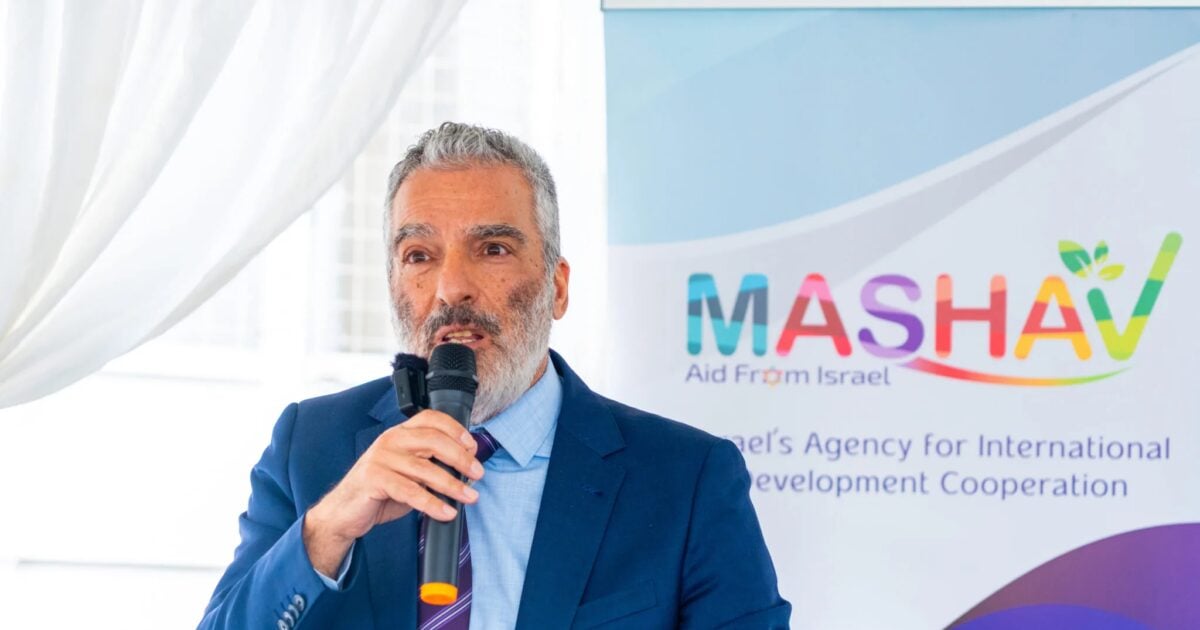
NAIROBI, Kenya, Nov 25 – Kenya and Israel have launched a goat and sheep training centre in Kiambu County to help farmers improve livestock breeding, animal nutrition and productivity through practical training and modern agricultural technologies.
The centre, located at 27 Farms, was launched on Monday through a partnership between the farm and Israel’s Agency for International Development Cooperation (MASHAV).
Speaking during the launch, Israeli Ambassador to Kenya Gideon Behar described the facility as a milestone in agricultural cooperation between the two countries.
“I think this is another milestone in the very long cooperation between Israel and Kenya in the field of agriculture,” Behar said.
The centre will offer practical training in dairy goat and sheep farming, animal genetics and feed production. It is also equipped with a feed pellet-making machine provided through MASHAV to help farmers improve livestock nutrition and manage feed supplies, particularly during dry periods.
Training is expected to begin in early 2027.
Behar said the facility was the first Israeli-supported training centre in Kenya dedicated specifically to goats and sheep. He expressed hope that it would become a model for similar initiatives in other parts of the country.
“This is a center of excellence, first-class activities in goats and sheep farming, and with Israeli assistance and local knowledge, I’m sure that we can spread more and more knowledge and more and more bring into the countryside and into the hands of the small farmers the knowledge of modern agriculture,” he said.
He said improving livestock breeds and farming practices was increasingly important as climate change, population growth and shrinking agricultural land put pressure on food production.
Israel’s contribution, he added, would focus on transferring agricultural knowledge, building farmers’ skills and providing technical support.
Behar also disclosed that Kenya’s Ministry of Agriculture was considering introducing the Assaf sheep breed from Israel, which he said could produce about five litres of milk a day. He said the ministry had started planning for the proposed introduction, with Israel expected to provide technical assistance.
He further indicated that another Israeli-supported training centre focusing on beekeeping was expected to be launched before the end of the year.
Peter Njenga, Deputy Director of Livestock Production at the State Department for Livestock Development, who represented the Principal Secretary, said improving animal genetics was essential to raising livestock productivity and meeting growing food demand.
Njenga, who works in animal genetic resource conservation, said selective breeding enables farmers to develop animals with desirable traits, including faster growth, greater body weight and increased milk production.
“Conservation of our animal genetics is very, very important in this country because it is through conserving and improving on those genetics that we are able to increase the production of those animals,” he said.
He said farmers could produce more food from smaller pieces of land by improving the productivity of individual animals rather than relying mainly on increasing livestock numbers.
However, he cautioned that efforts to improve breeds should not undermine the conservation of indigenous animal genetic resources, which carry traits that could be valuable for future breeding programmes.
“One negative aspect of improving production or improving the genetics is you continuously lose some very important traits. And these traits we also need to conserve them,” he said.
Njenga said the government operates 15 centres across the country dedicated to conserving indigenous animal breeds. He added that genetic improvement requires substantial financial investment, specialised expertise and time.
Kiambu County Chief Officer for Livestock, Fisheries and Veterinary Services John Kuria, who represented Governor Kimani Wamatangi, said the centre could help address challenges facing livestock farmers in the county, particularly the high cost and poor quality of animal feeds.
“One of our greatest challenges in livestock production in Kiambu is low quality of the feeds, coupled with high cost,” Kuria said.
He said the county government would work with the farm to provide technical support and train farmers, drawing on the expertise of county livestock officers.
“Through their cooperation, we will also be collaborating with the farm to train our farmers,” he said.
Kuria noted that the county was already supporting livestock production through programmes targeting women and young people and would seek to expand its focus on goat breeding and production.
MASHAV representative and agricultural expert Eitan Hatzor said the centre was developed following engagement with the farm’s management, which began during a goat farming course in Israel about two years ago.
Hatzor said animal feeds account for an estimated 60 to 70 per cent of livestock production costs, making efficient feed management critical to improving farmers’ returns.
He said the pellet-making machine would allow the farm to combine different feed ingredients into pellets designed to provide balanced nutrition for goats and sheep.
The equipment is also expected to support feed production for farmers in the surrounding area.
Jacqueline Gathura, Director of 27 Farms and a beneficiary of MASHAV agricultural training in Israel, said the farm had been working to improve its dairy goat and sheep breeds through selective breeding and the introduction of other genetic lines.
She said the farm initially focused on dairy goats before expanding into meat goat and sheep production. It currently keeps dairy goats, Boer goats for meat production and sheep, including crosses developed from indigenous Red Maasai sheep and Meatmaster breeding stock from South Africa.
Gathura said the crossbreeding had helped produce animals with larger body frames and greater potential for meat production.
She also demonstrated the farm’s zero-grazing system, in which animals are fed within the farm rather than left to roam in search of pasture.
The farm grows maize for silage, purchases additional fodder and is experimenting with lucerne cultivation to improve feed availability. Gathura said turning feed ingredients into pellets would make it easier to preserve feed for use during dry seasons, when shortages are common.
She urged farmers to consider alternatives to livestock systems that depend heavily on rainfall, particularly as changing weather patterns affect the availability of animal feeds.
The centre will provide an opportunity for the farm to share knowledge gained through its breeding activities and agricultural training in Israel with other livestock farmers.
“We are hoping to start training early next year,” Gathura said.
The launch builds on wider agricultural cooperation between Kenya and Israel, including programmes focused on irrigation, climate-smart farming and the transfer of agricultural technologies.
In August, Behar joined Kenyan government officials and agricultural stakeholders in Nairobi for a climate-smart agriculture event that explored how irrigation, practical training and modern farming technologies could help communities respond to changing weather patterns.
The new centre extends that cooperation into small livestock production, with a focus on breeding, animal nutrition and access to technical knowledge.
Farmers from outside Kiambu County are also expected to benefit. Livestock officials from Makueni and Taita Taveta were among those represented at Monday’s launch.
However, the organisers did not disclose how many farmers would be trained, the cost of participating or the full training schedule. Gathura said further details would be communicated ahead of the programme’s planned start in 2027.