Astronauts get tasked with all kinds of weird science aboard the International Space Station. Recently, NASA astronaut and Crew-13 commander Jessica Watkins got to work supporting an ongoing experiment that includes 3D-printing human cells and tissues in space.
What is it?
Aboard the space station, astronauts have a multitude of responsibilities ranging from station maintenance and repairs on spacewalks to daily exercise and a wide variety of scientific research.
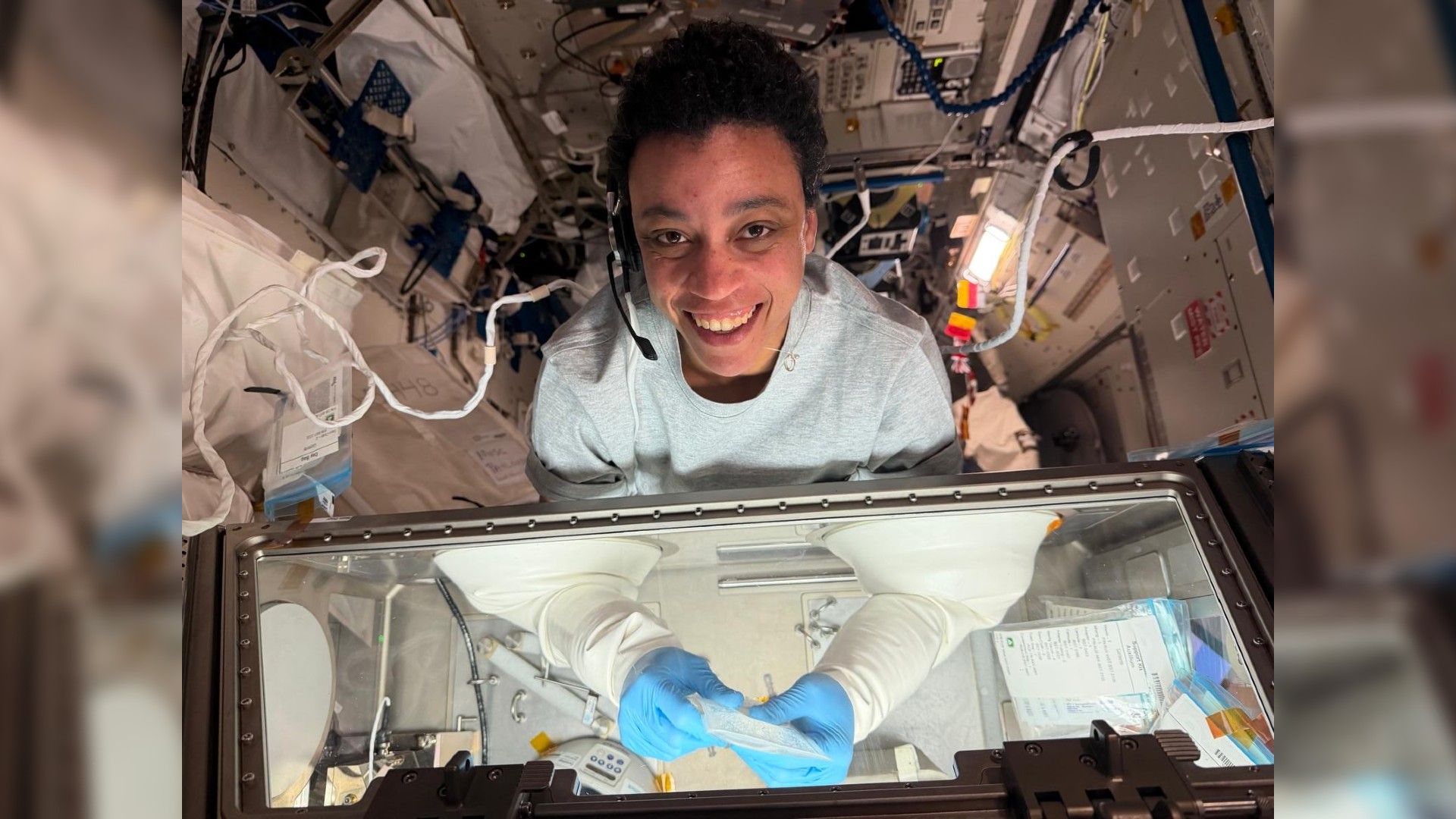
Watkins recently shared a snapshot captured by her crewmate Anil Menon that showcases her experience working on an experiment called InSPA-Auxilium Bioprinter-Cell Printing that takes place inside the station's Life Sciences Glovebox, a contained research space and one of Watkins favorite places to work on the space station, she shared on social media.
In the image she is gloved-up with both her hands and arms covered in the sealed glovebox while she mixes samples of living cells with a bioink, a mixture she then inserts into a specialized cartridge, NASA shared.
Why is it incredible?
This experiment that Watkins is working on "leverages the microgravity environment of ISS to 3D print cells and manufacture human liver, kidney, and cartilage tissue. Just one of many examples of how we’re using this amazing orbital national laboratory to reshape our understanding of biology, medicine, and engineering, and improve life on Earth!" Watkins shared online.
This experiment is designed to explore 3D printing human cartilage tissue in microgravity. The experiment aims to one day support future human patients both in space and on Earth.
When you think of the research that happens in space, 3D-printing human cells might not be the first thing to come to mind. But because of the unique microgravity environment onboard the ISS, it is the perfect home for even the strangest of biological experiments.
On the space station, there is still gravity but objects (and people) remain in a sort of constant freefall, leading to total weightlessness that mimics the complete absence of gravity. This weightlessness allows researchers to test, experiment and explore beyond the gravitational confines of Earth.