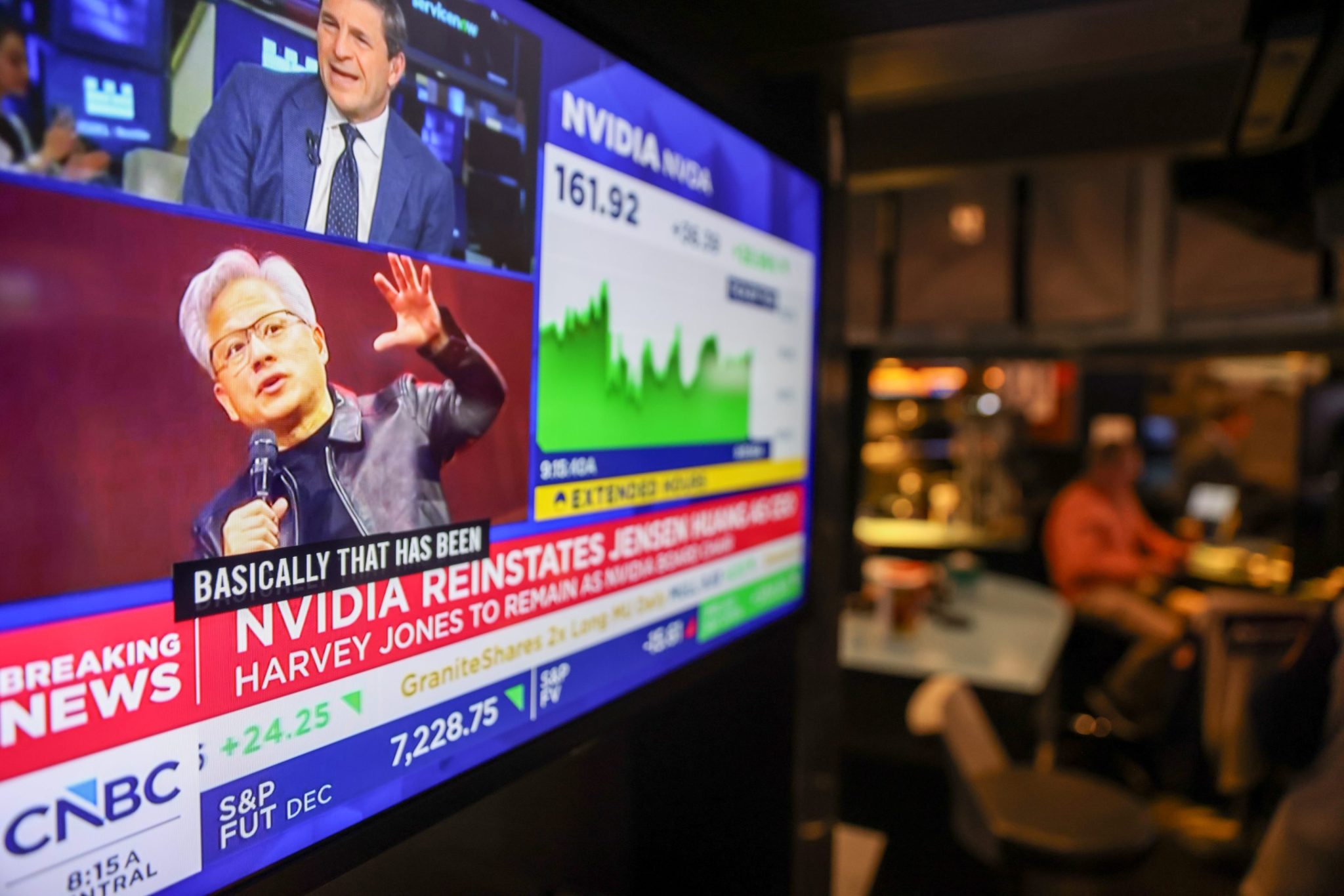
On Tuesday, Nvidia’s board chair said that Jensen Huang had violated the company’s code of conduct and that the former CEO had no future at the company.
On Monday, the chair welcomed Huang back with open arms.
The stunning flip-flop instantly made headlines and sparked a massive stock market rally, owing to Nvidia’s status as one of the world’s most valuable companies and the dominant maker of AI chips. It also brought immediate—and deserved—scrutiny to the corporate governance at the $4 trillion company.
Some governance experts slammed Nvidia’s board for its decision to rehire Huang as CEO, with one calling the board “incompetent” for its handling of his resignation and swift rehiring. But others said the board had little choice in the face of the plunge in Nvidia’s stock, widespread market turmoil, and pressure from shareholders and U.S. President Donald Trump.
“Morality and ethics just walked out of the back door for any large corporation,” Umesh Ramakrishnan, cofounder and chief strategy officer at executive search firm Kingsley Gate, told Fortune. “All the board had to do to advertise its incompetence was to reverse direction on the most monumental decision they’ve ever made together as a board within six days.”
The fact that several investigations have yet to be completed—including into Huang’s actions and reportedly into Nvidia’s accounting—added to the sense that the board acted rashly in reinstating Huang. But it also underscored the extent to which the leadership shakeup at Nvidia is light years away from being an ordinary situation.
That was made all the more clear as President Trump told CNBC Monday morning he had dialed into an Nvidia board meeting to directly advocate for Huang’s rehiring. (A White House spokesperson confirmed to Fortune, “President Trump was totally involved and this is a great decision by the NVIDIA board. We have to protect our geniuses.”)
“There was a gaping hole in the industry, and restoring stability to the markets and the AI industry, which is driving a significant portion of our economy, was paramount,” said Jeff Christian, CEO of executive search firm Christian & Timbers, and an expert on corporate governance. “The board had to act, and the market’s response demonstrates the stabilizing effect of bringing Jensen back. His continued absence was a greater detriment to the company than his reinstatement.”
Linda Ford, CEO of the Chartered Governance Institute of the U.K. & Ireland, said that Nvidia’s board was under unusual pressure because of Huang’s outsized role at Nvidia and the fact the board had failed to develop a succession plan prior to the current crisis. “The episode shows how hard it is for a board to hold its position when a company’s leadership is built around one person,” she said.
With Monday’s abrupt reversal, shareholders were sure to have questions, said Ford. “Boards can change their minds, but shareholders will want to understand what changed, particularly while the board’s own investigation continues,” she said.
A matter of duty?
Jesse Fried, a professor at Harvard University Law School who specializes in corporate governance, also told Fortune that the board was being true to its fiduciary duty in rehiring Huang. “At a high level, the board’s job is to generate long term value for shareholders and based on what I saw this morning, the stock market’s reaction was very positive so they seem to have served well the constituency they are supposed to have served,” he said, a perspective that was echoed by other experts Fortune spoke to.
Lindsey Stewart, director of Institutional Insights at Morningstar, said that many investors would probably welcome Huang’s return “given his history of value creation at the company.”
But she said that “alongside that sense of relief, there are sure to be questions about who is best placed to provide appropriate governance and oversight of key risks at the now-giant company at the center of a critically important global AI ecosystem. The Board’s decision to reappoint Mr. Huang, having only just accepted his resignation, leaves those questions unanswered.
Nvidia, which was founded by Huang 33 years ago, has long operated differently than most companies. Huang kept a firm grip on many of the company’s operations and had as many as 60 direct reports. There was no chairman of the board until Huang’s resignation, at which point Jones became the chair.
Penny Herscher, chairman of Lumentum Holdings and co-founder of The Chairs Circle, an organization dedicated to discussions on corporate governance, applauded Jones, the Nvidia executive chairman, for being “pragmatic.” “I’m sure he stepped back and looked at the situation and said, you know what, we’ve got to manage through this. We need Jensen back,” she said. “I’m sure they will now put a good CEO succession process in place, and they’ll re-examine all their governance procedures. I’m sure he and Jensen are in lock step together. They have a long friendship.”
Ford and several other corporate governance experts Fortune spoke to also said that the board should now put in place a clear succession plan. “If the board has learnt lessons from the past fortnight, it will show shareholders that it has a succession plan in place,” she said. Ramakrishnan also said the board should immediately begin a succession planning process, having seen the chaos that can occur without it.
Fried, of Harvard Law, said that Nvidia’s board would probably impose some kind of penalty on Huang—such as cancelling stock option awards or forcing him to take a pay cut—as a symbolic gesture to punish him for violating company policy through a reported romantic affair with a company employee, and possibly also for not being fully candid with the board about those affairs. But Fried said this would be a largely symbolic gesture.
Fried said Nvidia’s independent internal investigation would likely continue but that it would probably be “less harsh” on Huang than it would have been without him returning to the company as CEO. He also said Nvidia would probably never make the independent law firm’s full report on its investigation public, although lawsuits might eventually force the company to disclose a redacted version of it.
Political fallout
The decision to rehire Huang reverberated well beyond Silicon Valley. Several Democratic members of Congress expressed concern about Huang’s return. “The reckless decision to bring Jensen Huang back as CEO does not change the fact that Mr. Huang, NVIDIA executives, and the company’s board still owe Congress answers about the company’s compliance with U.S. export controls,” Sen. Elizabeth Warren (D-Mass.) said.
Warren said that Huang’s return increased the urgency for Congress to pass new export controls on AI chips.
Senator Chuck Schumer (D-N.Y.) also said the Trump administration’s decision to push for Huang’s rehiring underscored the need for Congress to act. “Trump is putting his own financial interests and the needs of his billionaire buddies before our national security,” Schumer said in a post on X. “The Democrats will wield their full power to investigate any wrongdoing by the Trump administration, Jensen Huang, other Nvidia executives, and anyone selling out our national security for financial gain.”
Reese, the NYU professor, also said that Huang’s rehiring raises troubling national security issues. “The reinstatement of Huang may provide stability and confidence for markets, but it spells real instability for national security and homeland security professionals,” he said.
Harvard’s Fried said that while Nvidia’s board would, in rehiring Huang, have taken into account the chances of a Democratic Congress—and maybe after the next presidential election, a Democrat in the White House—investigating the company for possible violations of U.S. export control laws. “It is hard for me to imagine a Democratic Congress or administration doing $1 to $2 trillion of damage to this company which is at the heart of the AI revolution in the U.S.,” he said, comparing that prospect to the amount of stock market value Nvidia was in danger of losing following Huang’s resignation. “I don’t see it hurting the company as much as depriving it of his unique leadership talents.”
This story was originally featured on Fortune.com