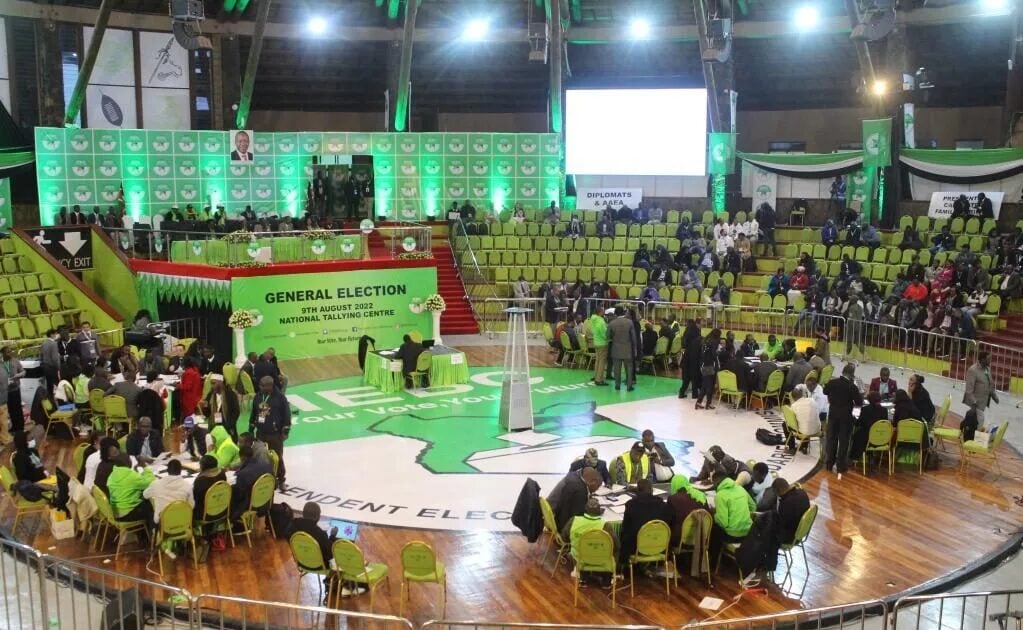
NAIROBI, Kenya, Nov 24- The Independent Electoral and Boundaries Commission (IEBC) will be guided by the Supreme Court’s interpretation of the law on presidential election results transmission, tallying and verification as it prepares for the August 10, 2027 General Election.
IEBC Chairperson Erastus Ethekon said the commission would operate within the constitutional and legal framework established by the courts, dismissing concerns that the National Tallying Centre could be used to manipulate or alter results declared at polling stations.
Speaking during a breakfast meeting with political reporters on Tuesday, Ethekon said the commission had no intention of introducing a new system outside the law, insisting that the courts had already clarified the respective responsibilities of IEBC commissioners and the chairperson in managing presidential election results.
“The Supreme Court itself has settled the issue of election results management. Nobody in IEBC is saying that we are going to reinvent something else that is outside the law,” Ethekon said.
He defended the National Tallying Centre, arguing that the commission was constitutionally mandated to collect, tally and verify presidential election results before the chairperson announces the winner.
The debate over the role of the national centre has intensified ahead of the 2027 elections, with questions raised over whether results declared at constituency tallying centres should undergo another round of verification at the national level.
In its September 5, 2022 judgment on the presidential election petitions arising from the victory of President William Ruto, the Supreme Court clarified that the mandate to tally and verify presidential results at the National Tallying Centre belongs to the IEBC as a collective institution.
The court ruled that the chairperson could not exclude other commissioners from the exercise, although the responsibility of declaring the final presidential results rests exclusively with the chairperson.
The judges also found that the chairperson did not enjoy special or extraordinary powers over the tallying and verification process.
The ruling followed the divisions that emerged within the commission during the 2022 presidential election, when four commissioners disowned the results announced by then chairperson Wafula Chebukati.
The court’s position is central to the ongoing debate over the management of presidential election results, particularly the distinction between tallying and verification at the national level and the declaration of results at polling stations and constituency tallying centres.
The Court of Appeal had earlier established the principle of finality of results announced at polling stations in the 2017 Maina Kiai case, ruling that the IEBC chairperson could not alter results declared by presiding officers.
The courts have subsequently reinforced the need to distinguish between the finality of results at the respective stages of the electoral process and the commission’s constitutional responsibility to establish the national presidential tally.
The issue was again tested in a petition filed by Busia Senator Okiya Omtatah, who challenged the constitutionality of national tallying and verification of presidential results.
On September 22, 2026, the High Court dismissed the petition, with Justice Gregory Mutai affirming that IEBC is required to tally and verify presidential results nationally.
The judge, however, made clear that the exercise does not give the commission powers to alter figures already declared and certified by constituency returning officers.
He ruled that national tallying involves aggregating constituency figures, while verification entails checking their accuracy against the certified records.
The court further directed that the exercise be undertaken collectively by commissioners, with candidates’ agents and election observers granted access to the same underlying information available to the commission.
It also emphasised that discrepancies between electronically transmitted results and physically delivered records must be documented, explained and made public.
The ruling has since informed Parliament’s consideration of proposed amendments to the Elections Act, particularly provisions governing the transmission, tallying and declaration of election results.
The Elections (Amendment) (No. 2) Bill, 2024, initially passed by the Senate, sought to repeal and replace Section 39 of the Elections Act, which governs the determination and declaration of election results.
One of the contentious proposals was contained in Clause 22, which sought to introduce a new framework for handling election results, including their declaration and transmission.
The Senate’s version also omitted the existing provision requiring IEBC to establish a mechanism for livestreaming results announced at polling stations, raising concerns among electoral stakeholders about transparency and public access to election information.
However, the National Assembly took a different position when it considered the Bill.
On October 22, 2026, MPs passed the Bill with amendments, deleting Clause 22 and retaining the existing Section 39 of the Elections Act.
The decision preserved the provision requiring IEBC to establish a mechanism for livestreaming results from polling stations for public information.
National Assembly Majority Leader Kimani Ichung’wah subsequently defended the decision, saying Parliament had taken into account the High Court’s September ruling when considering the proposed changes.
The Bill was, however, not yet law following the National Assembly’s amendments. It was required to return to the Senate for consideration of the changes under Article 110(4) of the Constitution.
The legislative debate is rooted in an earlier legal battle involving Katiba Institute, which challenged amendments to election laws enacted in 2017 following the annulment of the presidential election that year.
In Katiba Institute and three others v Attorney General and others, the High Court in April 2018 declared several amendments to the Elections Act and the IEBC Act unconstitutional.
The petitioners had argued that the changes undermined transparency, accountability and the independence of the electoral commission.
Among the contested provisions were amendments governing the electronic and physical transmission of election results, the use of technology and the declaration of presidential election results.
The court found that the provisions on transmission were insufficiently clear and could create opportunities for manipulation by undermining the requirement for transparent and verifiable election records.
It also ruled against provisions that treated electronically transmitted results as merely informational and allowed the failure to transmit or publish results electronically without affecting the validity of results declared by election officials.
The ruling was subsequently upheld by the Court of Appeal in October 2023 in National Assembly v Katiba Institute and six others.
The appellate court upheld the invalidation of Sections 39(1C)(a), 39(1E), 39(1F) and 39(1G) of the Elections Act, while maintaining the validity of Section 39(1D).
The litigation has remained significant in shaping the legal framework for election results transmission, particularly the requirement that electronic systems must support transparency and accountability rather than weaken the credibility of the electoral process.
Against this background, Ethekon said the commission would ensure journalists, political party agents, election observers and other stakeholders were involved in monitoring the results management process.
He dismissed suggestions that IEBC intended to conceal information at the National Tallying Centre, saying the commission would make the final stages of verification and declaration accessible to stakeholders.
“All these journalists will be there. Party agents will be there. The international community will be there. International media will be there. Election observers will be there. What more accountability are we asking?” he posed.
He said journalists would be allowed to observe proceedings at polling stations, the 290 constituency tallying centres and the National Tallying Centre.
The commission also plans to establish a communications hub where journalists can follow its activities and receive timely information on the electoral process.
Ethekon said IEBC would continue working with media houses under a memorandum of understanding signed with the media fraternity, which provides for regular consultations, information sharing and training on electoral processes.
He urged journalists to prioritise factual reporting and scrutinise claims by politicians rather than amplify unverified allegations about the electoral system.
The chairperson warned that misinformation, propaganda and hate speech could undermine public confidence in elections, discourage voter registration and threaten national cohesion.
He also announced that the commission would undertake enhanced voter registration from January 2027, with the exact commencement date to be announced.
He appealed to the media to support voter education and mobilisation as the country prepares for the August 10, 2027 General Election.