Sports in space have a long and proud tradition, whether it's Alan Shepard playing golf on the moon or the crew of the ISS hosting their own version of the Summer Olympics. The future looks bright as well, with the foundation of the Space Games Federation, the self-described "first governing and sanctioning body for competitive sports played in zero or micro-gravity," co-founded by a NASA astronaut.
Not to be outdone, science fiction has expanded the idea of zero-g and low-gravity sports to their logical extent, imagining everything from Doctor Who's zero-g squash to the advanced, gamified combat simulations of Ender's Game. There was even Space Jam's alien basketball game for the fate of the planet, though the gravity-defying antics there come from cartoon shenanigans rather than a zero-g playing field.
As humanity edges closer to colonizing our neighbors through projects like the Artemis Program and its ambition to establish habitats on the moon, our imaginations have to expand to encompass not only how we'll live in space but also how we'll play.
The rules change when gravity disappears
(Image credit: Zero-G)We rarely think about it in an Earth context, but every sport is heavily influenced by gravity. It defines how balls arc, how quickly players can move, and even how we orient ourselves in play spaces. Remove the gravity, and all of those assumptions and mechanics evaporate as well.
"First of all, in zero g, Isaac Newton will win every time," Les Johnson, former Chief Technologist for NASA, told Space. Les is a physicist with over 35 years of experience working at Marshall Space Flight Center in Huntsville, Alabama, as well as a science fiction author.
"'For every action, there is an equal and opposite reaction,'" quotes Johnson. "This is very difficult to simulate in real life due to gravity; special effects often try to compensate. With today’s AI and green screens, it can actually look good on screen."
In a microgravity scenario, the concept of up and down is no longer relevant. Suddenly, the playing field expands from a single, fixed plane to a fully three-dimensional space that includes height.
(Image credit: Netflix)Momentum is also a completely different beast. Instead of being able to quickly stop and pivot the way you can during terrestrial sports, once you start moving in microgravity, you keep going until something stops you. It takes the trickiness of moving on ice in sports like hockey and increases it by several orders of magnitude.
Of course, the havoc wouldn't stop with maneuvering yourself. Any ball or other object would also be subject to this altered set of physics.
As Johnson points out, "Aside from maneuvering the body and not tumbling or going in the wrong direction, the most difficult part would probably be throwing or hitting a ball in zero g. There would be no arc, just a straight-line throw. That would take getting used to doing, given that we’ve spent our entire lives calculating how high and fast to throw a ball in 1G so it gets to the person we intend."
Science fiction interpretations have often leaned into these differences; in many cases, low-g sports look more like three-dimensional chess than the highly physical contests we're used to here on Earth.
Zero‑g competition in sci‑fi worlds
(Image credit: Lionsgate Films)Ironically, many of the best examples of space-based sports are the most grounded, where real-world physics are fully accounted for.
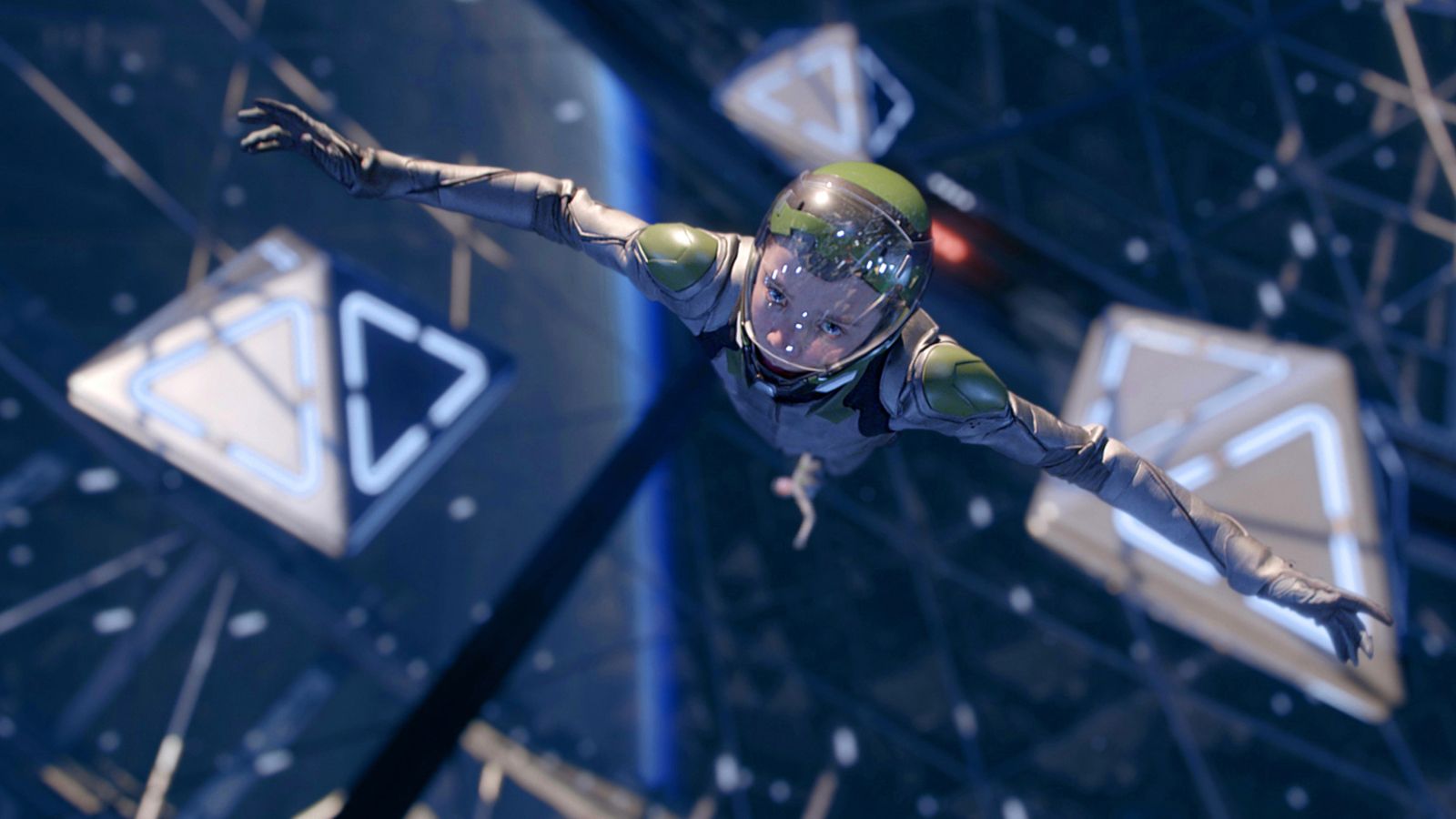
2013's "Ender's Game" gives us one of the best examples of a zero-g arena in space. Dubbed the "Battle Room," it's a giant hollow cube filled with obstacles. Teams enter through gates at opposite ends and participate in laser tag-style drills while having to grapple with three-dimensional space, while also finding ways to propel and protect themselves.
"The Battle Room sequence does a great job of thinking about straight‑line, constant‑velocity motion," Johnson said. "No 'reaction' to slow you down or change your direction. Characters push off walls or each other, then drift until they hit something or fire their suit's thrusters."
Johnson said Ender's Game also did an admirable job of showcasing how alternate physics require another layer of planning when moving through space.
"They went to great lengths to show that there was no preferred 'up' or 'down'. Again, very accurate and realistic thinking. Floating obstacles in the battle space created realistic constraints: if you don't think about where you'll rebound, you can pin yourself behind an obstacle or drift out of the fight."
Real proposals for space sports
Visionary artist Pat Rawlings sees the moon's one-sixth gravity as an excellent environment for athletic competitions. (Image credit: NASA/Pat Rawlings)Recognizing how important play can be (and, perhaps, acknowledging ways to combat the lingering specter of space madness), real-world space agencies have begun brainstorming what recreation in low gravity might look like. Some proposed ideas include 3D ball games not wholly dissimilar from the Battle Room, where players enter a cube or spherical arena and push off walls/pass a ball in any direction, scoring by hitting targets.
Elastic tethers are another experimental concept being bandied around, where players are connected to flexible tethers to improve movement control and cut down on collisions. The Space Games Federation has also floated the idea of a version of space basketball, where the goal is guiding a magnetic ball through hoops, as well as some version of space dodgeball.
Of course, these proposals are nothing more than thought exercises at the moment. We're a long way out from vast human populations living in zero-g environments for extended periods of time, and even further still from building spaceships capable of housing a sports hall.
NASA astronauts have experimented with trying to play various terrestrial sports in space, usually aboard the International Space Station. We've seen them playing soccer, lacrosse, and hockey with varying degrees of success.
These fun experiments mainly serve to prove what we've already suspected: that terrestrial sports can't be directly translated into a zero-g environment. We'll need new rules, arenas, and whole new games if we're going to make any headway with competitive sports in space.
Where sci‑fi gets it right (and wrong) about space sports
(Image credit: Ready at Dawn)Sci-fi has a pretty good track record for simulating open 3D environments in microgravity. The genre also tends to do fairly well in depicting the methodical pace of moving through space and how that would affect competition (and combat).
Games like "Echo Arena" even use technology to help simulate these factors. Echo Arena is a VR game where you boost around a zero-g arena, punching opponents and trying to toss a disc into a goal.
The game's innovative movement system allows players to grab almost any surface, either moving themselves along it or pushing off to float in a given direction. Players are also given wrist-mounted thrusters to let them course-correct a little, offering a respite from the unforgiving laws of motion.
Dead Space also has a section that functions similarly but with conventional game controls, though the only sport there is "don't get eaten by necromorphs."
With that said, there are areas where sci-fi portrayals of zero-G games fall down. Energy levels and fatigue is a big one: constant maneuvering with your arms is exhausting, which is why real astronauts rely heavily on handholds. In a similar vein, there's the issue of infinite momentum, specifically as it applies to rotation.
Johnson specifically quibbles with scenes in the Ender's Game Battle Room and "how quickly the participants can rotate their bodies or part of their bodies without going into an uncontrollable spin." He points to incidents where real-life astronauts have demonstrated how challenging this phenomenon would actually be. "I’ve watched many videos of astronauts on the ISS twist and then bounce off the wall or something. They have all looked very clumsy when they do this."
(Image credit: Lionsgate Films)The other kind of space constraints are also often hand-waved. Even the largest existing spacecraft pale in comparison to the size of stadiums or arenas on Earth. Our early attempts at space-based sports will likely have to be centered in much smaller playing areas.
Safety issues are frequently downplayed as well; colliding with metal surfaces at high speeds in enclosed environments risks serious bodily harm to players as well as potential damage to suits/gear.
With that said, newer sci-fi portrayals are getting closer to reality by emphasizing slower, more deliberate movement and placing the focus on strategic thinking rather than athletic prowess.
In the meantime, astronauts might have to stick to video games to scratch their competitive itches.