This story is part of a series called Shockwave: Rising energy demand and the future of the Great Lakes. The Great Lakes region is in the midst of a seismic energy shakeup, from skyrocketing data centre demand and a nuclear energy boom, to expanding renewables and electrification. In 2026, the Great Lakes News Collaborative will explore how shifting supply and demand affect the region and its waters.
On the north shore of Lake Ontario, roughly halfway between Toronto and Montreal, sits Greater Napanee, which was built on a small waterfall that tumbles into a river with its own tides. Upon its founding some 240 years ago, settlers raised a logging mill there. Then they built gristmills, sawmills and Canada’s first furniture factory — all running on the force of that river.
That history is documented on glossy but fading plaques along a now quieter, worn-out riverbank, each one highlighting the ruins of the few mills still standing, the ghosts of what no longer is. They’re easy to miss, hiding amid the shrubbery that has taken over the former industrial land. Plus, the river keeps your attention. On a 20-minute stroll, I spot at least four types of birds and the largest flock of geese I’ve ever seen. The river, I later learn, is a key migration stopover.
Today, Napanee is a storybook town of 17,000 people, made up of brick storefronts, colourful coffee shops and thrift stores, where vendors greet almost everyone by name. It looks like a place the industrial age left behind. It isn’t. Napanee is still a power town, where the electricity grid intersects with a Great Lake. It just doesn’t know it yet.
A few kilometres down the shoreline of Lake Ontario — or a 15-minute winding drive through farmland — sit two gas-fired power plants and one of the largest battery installations in Canada. There’s another energy storage project in the works a short distance away. There’s also a proposal to build a 250-megawatt data centre somewhere here, though where exactly, and who’s building it, is a mystery. What’s known is it will eat up more than an eighth of the electricity those gas plants can produce, though one is being expanded to produce even more.
What’s happening in Napanee is a window into the province-wide scramble for power. Ontario’s grid manager, the Independent Electricity System Operator, expects electricity demand to grow by 75 per cent by 2050. One driver is a promised wave of energy-hungry data centres built to sustain a new age of artificial intelligence. In Ontario, data centres have already asked for about 40 per cent of the power we’ve used in recent years.
Throughout Napanee, Ont., few people seem to know anything about a proposed data centre, including the local officials who have opened the door to it.But the scramble is also driven by industrial growth, a rising population, the shift of cars and heating to electricity. To keep up, the Doug Ford government is building on every front, which means speeding up approvals for complex and expensive projects that have huge potential community impacts. That includes more battery storage, more nuclear generation and, when nothing else is available, more methane-intensive natural gas.
These consequential decisions are being made in Toronto, at the provincial legislature in Queen’s Park. The resulting infrastructure lands in places like Napanee, where the people closest to it are often the last to know.
Over two days in town this month, I asked nearly 20 people about their understanding and perception of the proposed data centre and the many other energy projects nearby. The majority declined to comment; “I don’t know anything” was the most common answer, closely followed by “I don’t know enough.” The few who did chat with me shared deep concern about how little they knew about these potentially community-changing projects.
Napanee, a town that once turned a mill wheel, now hosts some 3,000 megawatts of gas generation — enough for close to three million homes — and has roughly another 400 megawatts in the pipeline. The gas will help charge more than 1,100 megawatts of new energy storage proposed around the town. Here are some of the sites. Map: Shawn Parkinson / The NarwhalOn paper, energy projects cannot be built without the support of an Ontario municipality. To win a provincial power contract, an energy company looking to build something here should get a resolution of support from its host council. Premier Ford and his succession of energy ministers since 2018 have repeatedly said they prefer communities to be “willing hosts” — though the province has applied pressure in some cases, leading to support that otherwise may not have existed. The province can also technically push a project through if a town says no, though Ford has said he will work with municipalities rather than “ramming something down their throat.”And while data centres don’t yet have a willing host requirement, Ford told reporters at Queen’s Park on Nov. 18 that, “If the municipality doesn’t want it, move it to another municipality that does.”
Energy Minister Stephen Lecce’s office did not respond to a dozen detailed questions sent by email about these projects, their cumulative impact on the community and the role residents and local leadership play in the approval process. Lecce’s office has not answered emailed questions from The Narwhal or granted requests for interviews since he took on the role in June 2024. The Narwhal also sent questions to the Ministry of the Environment, Conservation and Parks, which also did not respond.
When these energy projects have come around, Napanee has been willing more often than not, but with a massive asterisk.
“I guess you could say we’re open for business, but willing to shut the door if the project is not a good fit,” Angela Hicks, a town councillor, told me. “If the overall benefits aren’t good for the community, we’re prepared to say no.”
An Ontario data centre with no clear Napanee address — yet
There’s scant indication a data centre might be built in Napanee. One hint is a single line in the Independent Electricity System Operator’s application database.
It says that in 2025, a company called Napanee Environmental Complex Inc. submitted a project named “Napanee Data Park” to the provincial grid operator for approval, with plans to come online in 2028. That’s all the information that’s publicly available.
In an email, a spokesperson for the operator said the application is being reviewed according to technical assessments and provincial requirements. While the project “has not been approved to connect to the grid,” the spokesperson said the data centre has been accounted for in the operator’s 2026 forecast for the region, which projected electricity demand to grow 64 per cent in the summer and 58 per cent in the winter by 2044. All other questions, the spokesperson said, should be directed to the proponent.
The problem is the proponent doesn’t seem to exist. According to the Ontario Business Registry, Napanee Environmental Complex Inc. is headquartered in Brighton, Ont., an hour’s drive west of Napanee. It was incorporated in July 2016. The company has no listed phone number, email or website. In Napanee, I found one sign with the company’s name on it sitting on an empty parcel of land an eight-minute drive north of town. The phone number on the sign doesn’t work.
The Narwhal found one sign with the name of the company proposing to build a data centre in Napanee. The phone number listed doesn’t work.According to reporting from The Kingston Whig-Standard in June, Lazier Engineering, a firm that offers technical support to industrial and commercial projects, listed the company as a client. Lazier described the project as “the first of many data parks in Ontario,” noting it worked with Hydro One, the grid operator, government relations consultations and the Ministry of Energy to speed up electricity access for the park.
Lazier’s current projects page has since been scrubbed of any mention of Napanee Environmental Complex Inc. The Narwhal confirmed the Whig-Standard’s reporting using Wayback Machine, an internet archive, which showed the reference was still there in August. Lazier’s data park page now lists Amazon Web Service and Microsoft as the lead client of a project with a similar electricity load, with no location specified.
Lazier did not respond to questions from The Narwhal.
Right now, Napanee Environmental Complex Inc.’s empty plot of land sits at the foot of Goodyear Road, named for the Goodyear tire plant it leads to, the town’s largest and longest-serving employer. Along the way are industrial warehouse-style buildings, a few residences and a solar farm under refurbishment.
I walked into a quiet office in a building opposite the empty land, where I asked the manager if he knew anything about the proposed data centre. The sign reading Napanee Environmental Complex Inc. is visible from his window. “You’re the first person to tell me anything about it,” he said. To his knowledge, the site had once been farmland and now served as a dump for industrial waste. He had seen a government truck on it “the other day,” a provincial Environment Ministry-marked vehicle with a “spill action” sign.
As for data centres, “I don’t even understand what they are.”
No one seems to know much about the proposal, including local officials who have opened the door to them. (Most of them, including the mayor, did not respond to The Narwhal’s request to chat.) In February, Napanee council changed its zoning rules to allow data centres on every industrial property in town, calling it a “housekeeping” amendment. Previously, they had only been permitted in areas designated as “light industrial zones.”
“This was intended to provide a clearer and more consistent planning framework for industrial lands at a time when senior governments were identifying data centres and related digital infrastructure as an economic priority,” Michael Nobes, the town’s general manager of growth and infrastructure, told The Narwhal in an email. He added that the town has received inquiries and expressions of interest related to data centres, “but we have not received a formal municipal development application.”
“I don’t have any information either,” Councillor Hicks said. “I don’t know when it’s coming. Frankly, I don’t know what’s coming.”
The few hints have been strong enough to raise widespread concern. At an all-candidates meeting on Oct. 6, about 120 people watched as every mayoral and council candidate answered the same question: “Would you support a data centre in Greater Napanee?” None offered unconditional support. The newly elected council has yet to officially discuss the provincial government’s freshly proposed data centre playbook, which promised that new centres will fully cover their own electricity costs and invest in host communities.
Residents in Napanee are concerned about the impacts of all the energy projects, including the proposed data centre, on their water.“The bottom line is that we need to have a serious conversation about what kind of economic development we’re welcoming into our community, who actually benefits from it and what the long-term consequences will be,” Tiffany Lloyd, a Napanee resident and public school trustee, told me.
“I absolutely recognize the potential positive economic impact of a development of this size, and we need investment, but it cannot come at the expense of our land, our water, our health or the long-term well-being of our community.”
Now that local zoning laws permit data centres on industrial land across Greater Napanee, any data centre approved by the Independent Electricity System Operator could move forward without a public meeting or any council vote. Energy projects are different: before the province will contract a new power plant or battery, the host municipality must declare its support. Data centres face no such test, though being asked hasn’t spared the town its onslaught of controversial projects.
Napanee’s idle shoreline of other people’s power
The first sign of Napanee’s energy boom on my trip was two workers, clad in orange reflective vests and pants, in my hotel lobby. Their trucks, parked near mine in the lot, were marked with logos of two different energy projects. The concierge said this is how she knows things are happening in Napanee: workers, like these two, are constantly checking in and out. But when I ask about specific projects, she echoes everyone else: “I don’t know much, but I know there’s a lot.”
Today, a town that once turned a mill wheel hosts some 3,000 megawatts of gas generation — enough for close to three million homes — and has roughly another 400 megawatts in the pipeline. The gas will help charge more than 1,100 megawatts of new energy storage and whatever else gets added to the already long list.
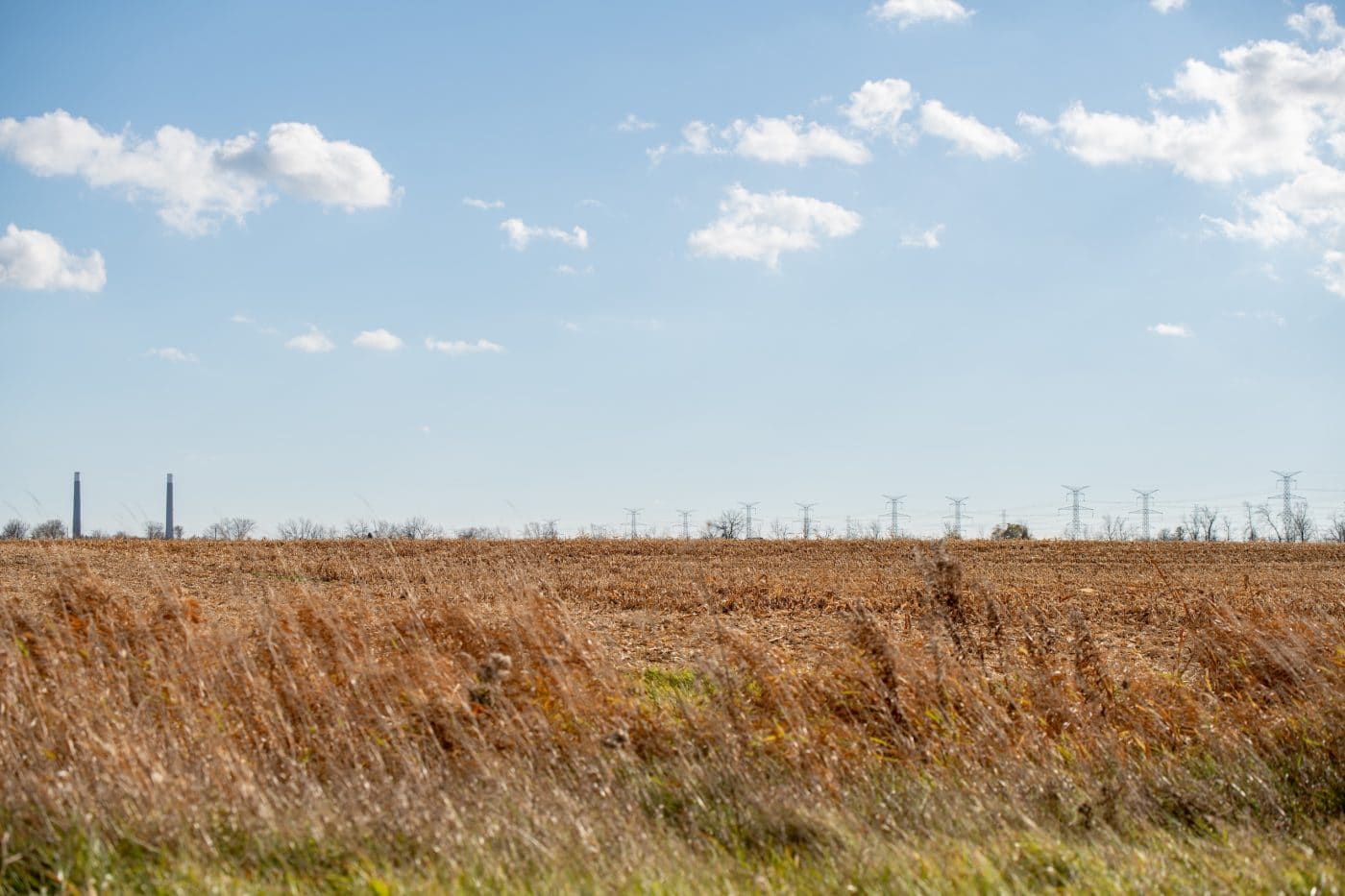
There are signs of energy on the horizon across Greater Napanee, including two gas plants, a solar farm and transmission lines galore.“It’s a lot for our community to take on,” resident Susan Moore said. She serves on the Lennox & Addington Stewardship Council, a non-profit environmental organization. “This is too much to keep up with. When I look at the possible negative effects — like the danger to our water source, pollution, noise and so on — from these projects in our area … it’s completely overwhelming and too difficult to fight or even understand.”
Moore isn’t alone in worrying about the environmental impacts of building a new energy-based economy in Napanee. She says the stewardship council’s inbox is overflowing with emails from residents across the region asking everything from how these projects work to how they’ll affect farmland and water. Her efforts to get answers from local officials and the companies have been futile, she said, adding that information seems unavailable for those who would be most impacted if something went wrong.
Beyond the data centre, energy storage projects are arriving in the farming town, designed to soak up surplus power from generators across southern Ontario, including nuclear stations, and then release it when demand is high. It’s a renewable energy source that the province has been increasingly reliant on, but the technology isn’t fully understood by the public. There are widespread concerns about noise, fire risk and loss of land.
Among these projects is one of the largest in Canada, the Napanee Battery Energy Storage System. It includes 284 batteries with enough power for about 250,000 homes. Construction on a second phase is set to start in 2027.
A five-minute drive away, a partnership between Toronto-based Hydrostor and the Mohawks of the Bay of Quinte would see the construction of a type of energy storage facility new to Canada. This one would use excess energy from the grid to pump compressed air into a cavern deep underground, which would push water up into a reservoir on the surface. When that water is released down, it would generate power to send back to the province’s grid.
In an email to The Narwhal, Shaheer Aziz, vice-president of commercial and business development at Hydrostor, said this technology “is emissions free, was developed in Ontario, will rely heavily on domestic supply chains and will create more than 650 local jobs during construction while supporting thousands more.”
A new type of energy storage facility, made in partnership with Hydrostor and the Mohawks of the Bay of Quinte, would use a lot of water and is proposed on about 100 acres of privately owned farmland.“The technology doesn’t rely on fuel, just water, rock and air, meaning that it poses significantly less of a safety and environmental risk than many other energy technologies,” he added, noting that the project can provide enough electricity to power the homes of 500,000 people, double the number of households in Mississauga.
But it does require a lot of water.
Hydrostor would need to build a pipe to Lake Ontario to source 1.4 million cubic metres of water for the project, which is about a year’s worth of household water for everyone in Napanee. As council debated the proposal, the Cataraqui Region Conservation Authority — which monitors the region’s watersheds — questioned whether this was feasible, seeing as a pipe would have to go around or through nearby wetlands.
A day before town council voted on the project, the authority sent a letter warning of “significant uncertainties” about how the project could affect groundwater. The site may sit on karst — fractured limestone where water moves fast and unpredictably. If Hydrostor drew from local aquifers, the authority wrote, that unpredictability might mean insufficient water for neighbours.
The conservation authority asked for more study and an independent peer review before the project went any further. The next night, council voted to support moving ahead with planning, with the town planner promising studies before construction began. The Cataraqui Region Conservation Authority did not respond to questions from The Narwhal.
Aziz said the company has planned for “multiple levels of safeguards” to mitigate impacts on groundwater resources, and is in active discussions with the town, the Environment Ministry and Mohawks of the Bay of Quinte about “several viable options for procuring water.” He added there are more conversations to be had with the community that will host this project for more than 50 years beginning in May 2027, including discussions about their eventual studies on groundwater, noise and traffic.
The Mohawks of the Bay of Quinte responded to The Narwhal, but were unable to provide a comment by publication.
But concerns don’t end there. The storage project is proposed on about 100 acres of privately owned farmland — in a province where 319 acres of farmland disappear daily because of development. A member of the family that owns the land declined to comment when I pulled into the driveway. Though Aziz confirmed the site is secured, there are no signs of Hydrostor’s impending arrival on the county road yet, just swaths of corn fields being harvested, with the gas plants on the horizon.
The Lennox Generating Station is a focal point while driving around the farmlands of Greater Napanee.Ontario’s energy plans hold tight to natural gas in Napanee
Napanee’s relationship with controversial energy projects started long ago, beginning with the Lennox Generating Station. The gas plant would be the tallest structure in the region if not for the transmission line that connects it to Ontario’s power grid. Its two stacks loom over hilly farmland and the deep blue lake, visible from almost every vantage point in a five-kilometre radius. In November, no greenhouse gases appear to fume from the stacks, but there could be at any time.
Lennox has long been the province’s back-up power supply — or “critical insurance policy,” according to the company’s spokesperson — used mainly for emergencies, the coldest mornings and the hottest afternoons. Built by the provincial government in the 1970s, it was initially designed as the only fossil-fuel station that would burn oil rather than coal. But nuclear power was coming online, too, and within a few years, Ontario had more than enough power.
Today, Lennox runs on gas, enough to power 2 million homes, and sits mostly silent. In 2013, the Toronto Star reported the plant, which is run by Ontario Power Generation, was collecting about $7 million a month from the province while running at 1.5 per cent of its capacity.
Both Lennox and Napanee generating stations are on the shores of Lake Ontario.Despite this infrequent use, in 2023 the provincial government gave Lennox special permission to overshoot Ontario’s cap on the amount of sulphur dioxide and nitrogen oxides allowed to be released when burning oil. The decade-long approval requires Ontario Power Generation to warn residents — with information on health effects — when pollution near the plant spikes. The company did not directly respond when The Narwhal asked when, if at all, the plant has burned oil, how much of these gases the plant has emitted in the last few years and other questions about its operations.
Next door to Lennox is another gas plant, which was built here because another community said no. In 2010, residents of Oakville, west of Toronto, resisted a gas plant proposed near thousands of homes, multiple schools, a hospital and a highway, in part because of the methane emissions it would release. In response, the then-Liberal government infamously cancelled it and promised not to build near the Greater Toronto Area. It was sent to Napanee instead, where it sits two kilometres from Lennox, which critics say was underused even then.
The Napanee Generating Station is run by Atura Power, a subsidiary of Ontario Power Generation. It hasn’t been a quiet neighbour for those who live nearby, including in Prince Edward County or Amherst Island in Lake Ontario. On a cold and windy November evening, a mechanical hum filled the air, even with the plant running at limited capacity through construction; in May 2024, the grid operator approved an expansion of the facility, and not everyone is happy about it.
The Napanee Generating Station was first proposed in Oakville, where residents rejected it.Residents have complained of constant humming, vibration, loud bursts and lost sleep, according to internal Energy Ministry records first obtained by Kingstonist and later by The Narwhal. These documents also show a murky approval process, in which the Ontario Environment Ministry’s own modelling showed the expansion could potentially exceed provincial noise limits before the project was greenlit in December 2025. The ministry gave Atura up to 13 years to install permanent fixes to dampen the sound, if an audit found a problem.
These problems are concerning, as the province’s dependency on gas plants is growing. Ontario’s grid operator expects to lean on gas plants to cover peak demand while a big chunk of nuclear reactors go offline for refurbishment and electricity demand climbs. Last winter, as record cold pushed up demand, Ontario Power Generation said Lennox’s four units “worked hard.” Perhaps as a result, the government has extended Lennox’s contract to 2034, and approved the Napanee Generating Station expansion that will enable it to operate until 2040.
For those who live nearby, that is a long time. How much longer these gas plants will run is a number neither the power generator nor the provincial government has given residents. Nor has anyone told the town how much more carbon dioxide and smog-forming pollution could drift from their stacks if it does. In a statement, Atura Power told The Narwhal its Napanee station “operates in compliance” with all provincial environmental requirements.
The Napanee Generating Station hasn’t been a quiet neighbour for those who live nearby, including Amherst Island in Lake Ontario, seen here. With an expansion underway at the plant, residents are concerned about the noise and pollution levels in the years ahead.In separate statements, both Atura and Ontario Power Generation said they are not in conversations about supplying electricity to any of the surrounding Napanee energy projects, including the proposed data centre. Both also said past decisions — to expand the Atura gas plant, and extend operations at Lennox — were unrelated to the data centre project.
While the province’s explanations of where a new supply of energy will go are more big picture, where it will come from is squarely focused on Napanee, and other pockets of small-town, rural Ontario.
“There’s fear and anxiety that the very nature of the community will change,” Moore said. “Our farmers, our farmland, our water. I don’t think the broader public realizes how drastic the change could be.” She wonders if it’s easier to get such projects built in towns like Napanee because, unlike Toronto or Ottawa, its economic options are limited.
The Greater Napanee city council has backed nearly all of this change. Only one councillor opposed Atura’s gas expansion in November 2023, which came with an offer of up to $400,000 a year in community benefits for the plant’s first 12 years of operation, which the town can spend as it chooses. Council also approved the first phase of the Napanee Battery Energy Storage System in January 2023 and the second this September, with a benefit deal giving the town $600,000 a year for two decades. It backed Hydrostor’s energy storage project in May, which came with a commitment of up to $1.3 million a year if it’s approved by the grid operator for a 40-year contract, and unanimously endorsed a bigger version in October.
Greater Napanee council has supported the progression of most of the energy projects that have been proposed here, even as residents worry about impact on their way of life.To date, council has only refused one project, a 200-megawatt battery proposal with a substantial footprint on prime farmland, after residents objected.
Come the new year, growth and infrastructure manager Nobes said, the town will have a framework that will make clear how this benefit money will be used. Nobes said the town’s intent is to put some of the funds in reserve and use a percentage for targeted community initiatives like “much needed infrastructure renewal, new recreational opportunities for the community, etc.”
“There’s a perception that if a town approves one project, it’ll support everyone else that comes to town,” Hicks said. “I’m not surprised when something is put forward. There’s a place for these kinds of projects, but we get to decide if our town is the place for that project.”
Of course, she said, a town and its residents can only do that if they have all the information.
The Narwhal’s reporters are telling environment stories you won’t read about anywhere else. Stay in the loop by signing up for our free weekly dose of independent journalism.