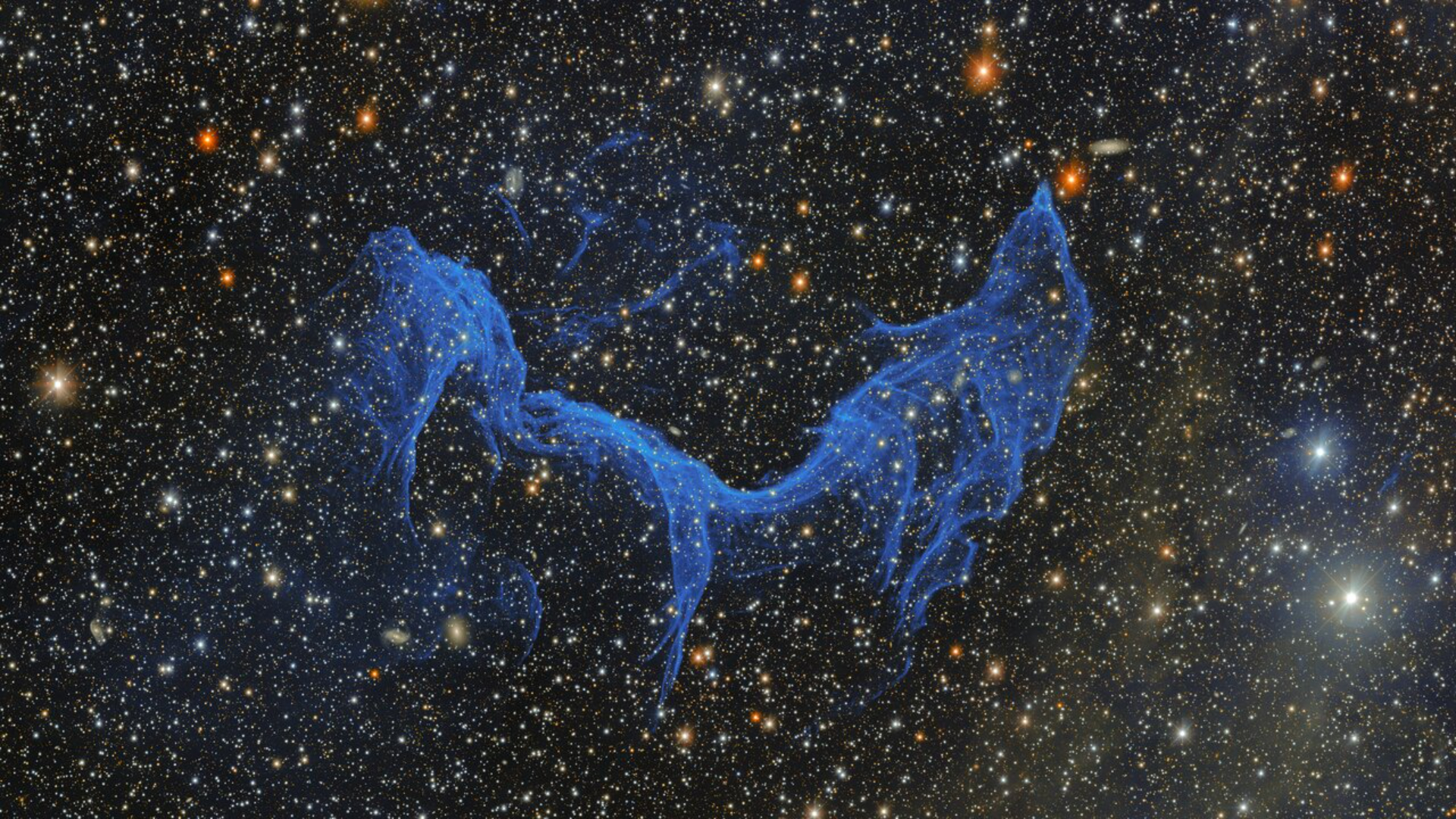
The striking blue of the Betta Fish Nebula swims across the cosmic landscape, a stunning wisp of material leftover from a stellar explosion.
What is it?
Roughly 6,800 light-years from Earth and nestled in the Centaurus constellation, this piece of the supernova remnant SNR G295.5+09.7 has earned the nickname the Betta Fish Nebula for its floaty, fishy shape.
This almost ghostly whirl of gas and dust was created when a star much more massive than our sun exploded, blasting its outer layers of material outward in the process. Over time, the remnants of this supernova eruption stretched outward into space, dispersing and colliding with surrounding gas. The explosive remnants mixing with gas in the interstellar medium created this glowing, blue cloud.
This celestial scene was captured by the Dark Energy Camera (DECam), that was created by the U.S. Department of Energy. The camera is installed on the National Science Foundation's Víctor M. Blanco 4-meter Telescope in Chile.
Why is it incredible?
This image of a colossal, cosmic "fish" was captured by a camera meant to study the illusive effects of dark energy, which is the name scientists have given for whatever mysterious something is causing the universe to expand at an accelerating rate.
The camera is used as part of the Dark Energy Survey, a six-year, international collaboration in which scientists have collected observations of hundreds of millions of galaxies, thousands of supernova and additional details about our cosmos that could help to fill in the picture of the nature of dark energy.
And while researchers this past January revealed the initial result of this six-year survey, scientists continue to explore the possibilities of dark energy with DECam alongside instruments like the recently-launched Nancy Grace Roman Space Telescope.
However, while the survey has lofty goals with its DECam data, the camera can also capture beautiful imagery like this cerulean wisp thousands of light-years away.